


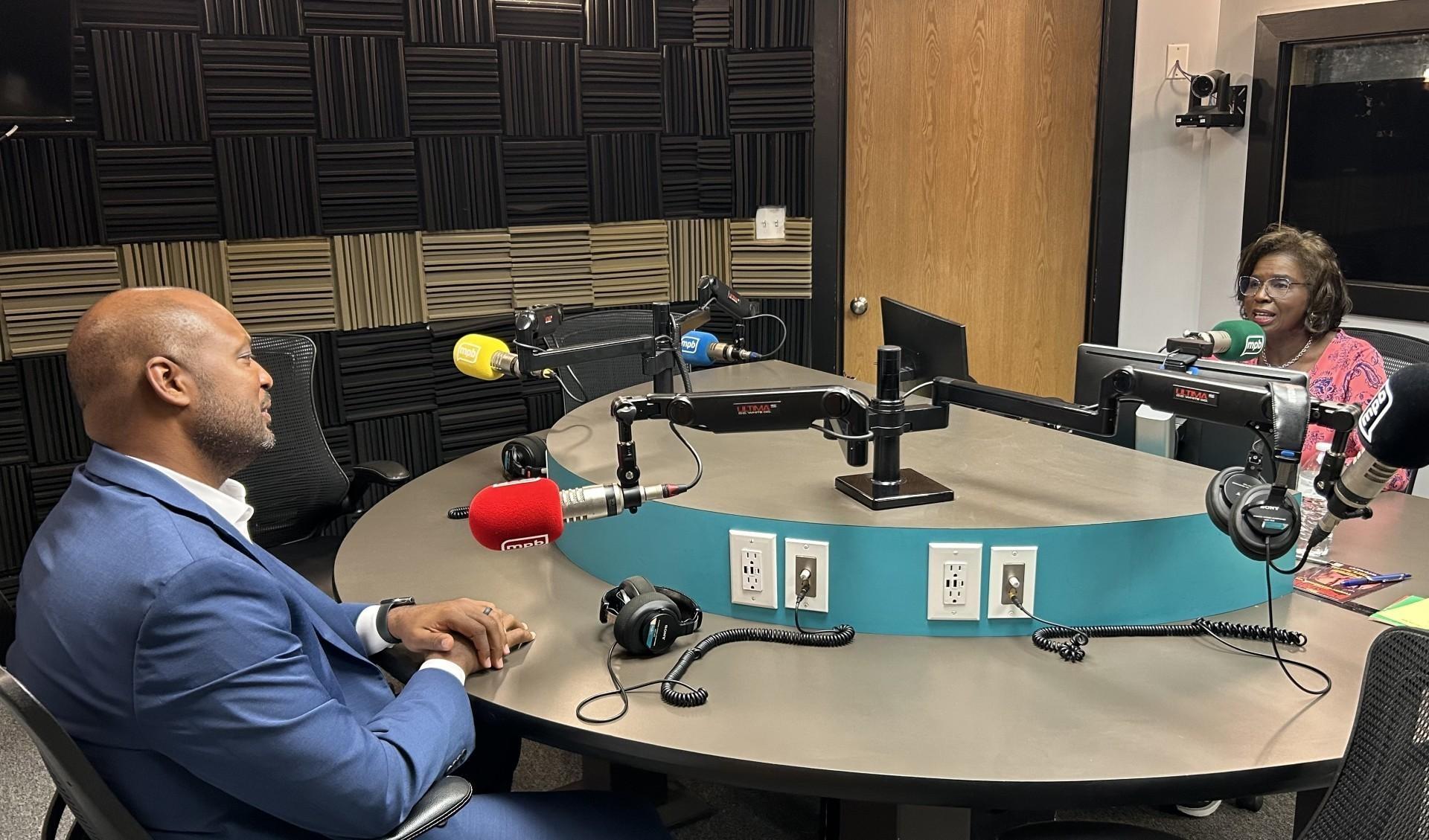
As colleges across the country face enrollment declines, financial pressures and growing competition for students, Tougaloo College's new president says the historic institution will lean into its identity rather than retreat from it. Dr. Corey Wiggins, who became Tougaloo's 15th president on July 1, says the college is focused on strengthening its operations, expanding economic partnerships and building on its legacy as a leader in education and social justice.
A Hazelhurst native, Wiggins brings a background in public health, public policy and economic development to the role. Before joining Tougaloo, he served as executive director of the Mississippi State Conference NAACP, held leadership positions at HOPE Enterprise Corp. and was appointed by President Joe Biden and confirmed by the U.S. Senate as federal co-chair of the Delta Regional Authority. He earned a bachelor's degree in biology from Alcorn State University and master's and doctoral degrees in public health from the University of Alabama at Birmingham.
In a recent conversation with Mississippi Matters, Wiggins discussed his unconventional career path, the challenges facing higher education and his vision for Tougaloo's future.
FRAZIER: I noticed your background varies. You've been executive director of the Mississippi State Conference NAACP, a leader at HOPE Enterprise Corporation on local, regional and national policy issues, a visiting assistant professor at Jackson State University and, prior to joining Tougaloo, federal co-chair of the Delta Regional Authority.
From studying biology to going into economics and now leading a private historically Black college, would the younger Mr. Wiggins have thought this would be the route he would take?
WIGGINS: Not at all. The first thing I ever wanted to be was a cartoonist. Then I transitioned from that to wanting to be an engineer. Then I settled on being a physician.
I majored in biology at Alcorn. I was at Tougaloo as a summer science student. I went to Alcorn State University on a football scholarship.
After graduating, I went to UMMC and did research in immunology and physiology. They didn't have a dual M.D./M.B.A. program.
I decided to go to UAB to get a degree in health policy.
Before that, I did a fellowship on Capitol Hill through the Kaiser Family Foundation's Barbara Jordan Health Policy Scholars Program. That's where the shift happened. As a physician, I can impact one patient at a time, but through public policy I can impact thousands of people at one time.
FRAZIER: You're now at Tougaloo College, which was founded by an abolitionist organization in 1869 and chartered by the Legislature in 1871. Students were heavily involved in the Civil Rights Movement. How would you describe the college today in terms of the educational and political climate?
WIGGINS: Part of our mission is teaching students to be lifelong learners, to lead and to serve. It has always been a voice and a conscience for justice. It remains important today.
We talk about our tagline, "Where History Meets the Future." Whether we're talking about what's happening politically in the country, economic mobility or how we educate young people, I think that's the moment we're meeting at Tougaloo College.
FRAZIER: You began the job July 1. You were confirmed in March. Have you been able to identify priorities right out of the gate? What do you see as the goals?
WIGGINS: I think there are a lot of institutions that, in this moment in history, are running away from who they are. At Tougaloo, we're going to lean into who we are as a justice-oriented institution.
Operationally, we're going to work to strengthen our internal operations as a college.
FRAZIER: What does that look like?
WIGGINS: We have to operate well as an institution. While we are delivering an education, serving our alumni and serving our community, our ability to do that depends on running well as an institution.
FRAZIER: Administratively?
WIGGINS: Yes. We don't always talk about that in the context of higher education. There is a business-model component within higher education, and we have to run and work well.
FRAZIER: How many students do you have?
WIGGINS: We have between 500 and 550 students.
FRAZIER: What are some of the subjects and degrees you offer?
WIGGINS: We have always been strong in the sciences and natural sciences. We are one of the leaders in Mississippi in producing African American physicians, dentists and researchers, and we have a national impact in that area. I met my wife at Tougaloo, and she's a dentist now herself.
We also have a strong pre-law program. Some of Mississippi's leading attorneys came through Tougaloo. We produce leaders in the humanities, English and the arts.
FRAZIER: When talking about the student body at a historically Black college, what are some of the major challenges? Some are probably the same as majority institutions when it comes to funding and enrollment.
WIGGINS: You're right. These challenges aren't unique to Tougaloo. Institutions across higher education are grappling with the enrollment cliff. The number of students entering two-year and four-year institutions is getting smaller.
That increases competition. As a private institution, we don't get state support. We are tuition-driven.
But it's not just enrollment. It's also about making sure we're retaining our students. We own that responsibility.
The thing that keeps me up at night is how we shift our revenue model. We have student tuition, grants and donor support, but we still have to diversify further. Where are the opportunities for innovation?
We're situated between Hinds and Madison counties, and there's so much development happening around us. It is important for us not only to have a seat at the table, but to be a leader in that development. We need opportunities that allow us to innovate and ensure long-term sustainability.
FRAZIER: What does a partnership with Tougaloo look like when it comes to economic development?
WIGGINS: You have Amazon Web Services to the northwest of us. You have tourism-related development happening to the northeast. There are discussions about additional convention and entertainment developments nearby. To the north, you have the Renaissance area. To the south, there are residential development opportunities.
FRAZIER: Does that mean getting these folks on your board or creating internships for students?
WIGGINS: Both. We're talking about trustee engagement, as well as opportunities to engage with AWS and its data center operations.
How do we connect our students to emerging workforce opportunities? How do we identify resources that allow faculty to do research and create opportunities for students?
We have land. You mentioned the 500-acre campus. How do we leverage that in a way that improves quality of life, whether through housing, green space or mixed-use retail development?
Those opportunities require foundational infrastructure such as water and sewer. I believe we can put those assets in place and engage developers and alumni to improve quality of life and create training opportunities.
FRAZIER: Are you sensing excitement?
WIGGINS: I am. Imagine a big boulder. You've got to rock the boulder to get things moving. Sometimes it will rock forward and sometimes it will rock backward. But you've got to keep rocking to build momentum and keep moving forward.
FRAZIER: The viability of HBCUs is often debated. Mississippi also faces a brain drain as college graduates leave the state. How do you support a historically Black college and keep it competitive?
WIGGINS: This debate about the relevance of HBCUs has always existed. I think it's futile.
The conversation should focus on the value we create.
When you look at the work our alumni are doing today, tell that story. Lift that up. That's the value we are creating.
The climate was difficult for Fannie Lou Hamer. The climate was difficult for Medgar Evers. The climate was difficult for SNCC veterans. That didn't stop them, and it's not going to stop us.
Part of that is collaboration, engagement, executing our plans and having the ability to reassess and course-correct when necessary.
FRAZIER: Do you offer any classes or programs in conflict resolution and helping young people navigate disagreements?
WIGGINS: Because we have a small campus setting and small classes, we do a lot of that work, particularly with first-year students and students new to campus, helping them learn how to engage with one another.
FRAZIER: Dr. Corey Wiggins, the new president of Tougaloo College, thank you for taking the time to speak with us.
WIGGINS: Thank you for the invitation to be here.