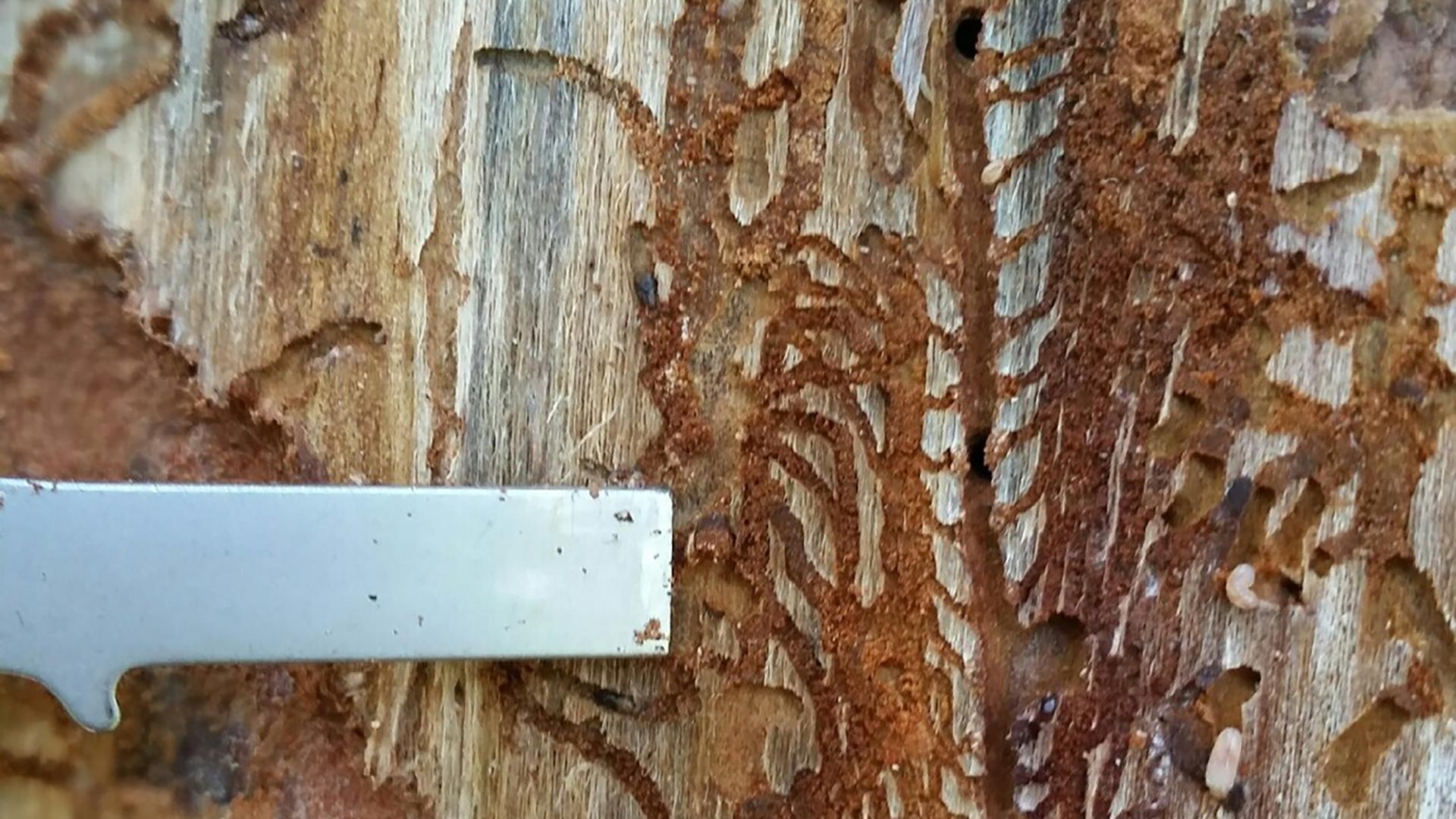
That’s especially true for pine trees whose needles have already begun to turn brown or red. Pine bark beetles can be tinier than a grain of rice, so knowing they’re present can take time. Although a lot of damage will be most obvious in late spring, Hicks urges landowners especially in north Mississippi, the region hit hardest by the winter storm, to look out for signs of beetle damage like pitch tubes.
“It's little hardened, dried little balls of sap that the tree has pushed out to try to keep the beetles from attacking it,” he said. “So you'll see these little white, dried, we call it kind of like a popcorn kernel. If you're seeing those, that's a good indicator of beetle infestation.”
Dust found along the bark of the tree can also indicate that beetles have bored in. The forestry commission is conducting its own beetle surveillance to understand the extent of the problem.
“We are currently doing some trapping to try to get an idea of what type of beetle population we have out there right now, to see what that impact could possibly be from this ice storm damage,” said Hicks. “We're also going to be conducting what we call our forest health monitoring flights where we actually fly across the state using our aircraft to identify and locate possible beetle outbreaks or beetle damage on the forest landscape.”
Landowners who want to tackle the problem on their property should determine what type of pine beetle they’re battling.
“If you've already got a lot of ips beetles now in March and April, that's a real concern,” said Butch Bailey, an Extension Forester for Mississippi State University. “You might need to be more aggressive in your treatment. If you had that same amount of impact in October, November, we usually tell you just kind of, you know, just chill out. It'll probably go away this winter.”
Bailey said there are management strategies to mitigate southern pine beetles and ips beetles if they are present in the spring. “We don't really have effective spraying or pesticides for forestry situations, but there are things you can do as far as cutting out that bug spot, cutting a buffer strip,” he said.
With southern pine beetles particularly, Hicks from the Forestry Commission said, “You can do what they call a cut and leave method. You can cut the tree, leave it laying in the forest because they cannot complete their reproduction cycle and those downed trees due to once you lay it on the ground, the sunlight gets down and really heats that tree up. They do not like heat.”
Bailey Mississippi State University Extension service said the beetles also make forests in the state more susceptible to another major issue. Broken limbs, trunks and branches create major fuel for fire.
“So it absolutely, in these affected areas, could make your wildfire risk higher. More to the point, it changes how the Forestry Commission has to go fight these fires.” said Bailey. “You know, the way you fight wildfires in the South is with bulldozers and plows. And you basically plow around it and make a dirt area where the fire can't burn across. Well, if they can't get equipment in there because of all this downed and damaged timber, they have to big box it and they make a bigger area and plow around it so you lose more timber on the inside of that.”
Bailey said all 82 counties in the state have farm service agencies that can assist with finding financial assistance for landowners.
“These are their investments for their kid's college or for their retirement,” he said. “You go out and you talk to these people and in some cases, it's devastating and these take a long time. You can't just rebuild a forest overnight.”