Your Page Title

Civil rights icon Fannie Lou Hamer’s Presidential Medal of Freedom goes on display in Jackson

Email share
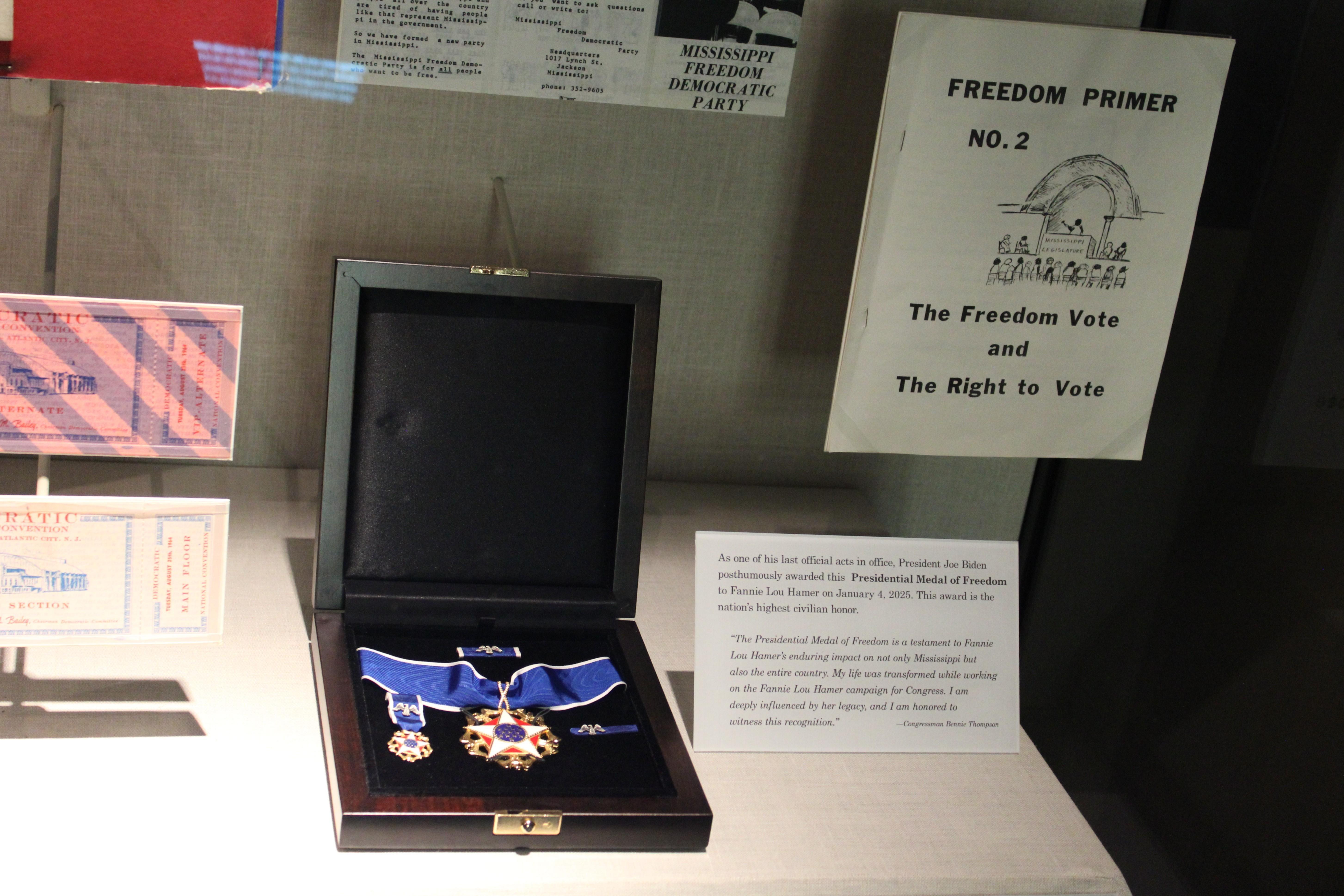
The Presidential Medal of Freedom awarded posthumously to Fannie Lou Hamer is seen on display February 10, 2026.
(Shamira Muhammad, MPB News)

Civil rights icon Fannie Lou Hamer’s Presidential Medal of Freedom has gone on display at the Two Mississippi Museums in Jackson. The announcement coincides with Black History Month.

Hamer’s medal was awarded posthumously last year by President Joe Biden. It is considered to jointly be the highest civilian honor possible, alongside the Congressional Gold Medal. The award will be displayed in a gallery of the museum bearing the name of Hamer’s famous speech, 'I Question America.'

Shamira Muhammad

Fannie Lou Hamer's Presidential Medal of Freedom is on display in Jackson

00:0000:00

Born October 6, 1917 in Montgomery County, Hamer became a leading voting rights activist and played an instrumental part in the Civil Rights Movement. She was a co-founder of the Mississippi Freedom Democratic Party and an organizer of Freedom Summer. 

“When I think of Fannie Lou Hamer, for whatever reason the word dignity comes to my head,” said Michael Morris, executive director of the Two Mississippi Museums. 

The activist was not allowed to return to the farm where she and her husband worked after Hamer attempted to register to vote in 1962. Shortly after, she was threatened with physical violence and in a separate 1963 incident, Hamer was arrested and severely beaten. 

Her activism continued and in 1964, a speech at the Democratic National Convention brought Hamer national recognition. 

“She was a powerful orator and she was a genius in terms of describing her circumstances and the circumstances of so many of the Black Mississippians,” said Morris. 

Popularly known as 'I Question America,' the speech occurred after Hamer and other delegates were denied seats at the convention’s Mississippi table. 

“If the Freedom Democratic Party is not seated now, I question America,” Hamer said at the time. “Is this America, the land of the free and the home of the brave, where we have to sleep with our telephones off of the hook because our lives be threatened daily, because we want to live as decent human beings in America?”

Delivered in a voice that carried the weight of the Mississippi Delta, Hamer gained the attention of both her White peers and Black men in the Civil Rights Movement, some who had initially disregarded her.

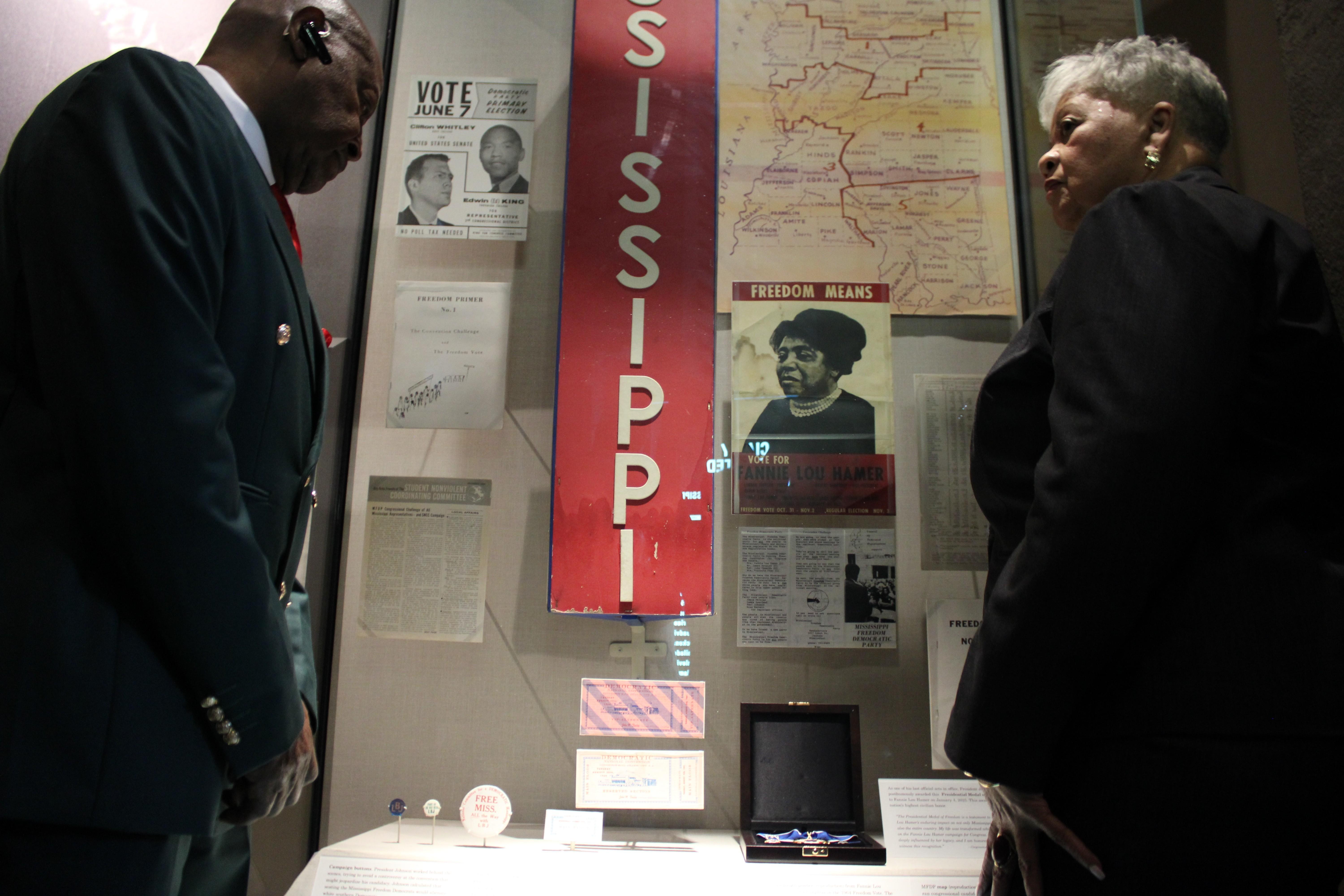
Hamer's nephew, Eddie Fair, and niece, Marilyn Mays, react to her medal's display.
(Shamira Muhammad, MPB News)

“Males in the movement, they had a place for her but she didn't settle for that place,” said Marilyn Mays, Hamer’s niece. “She did what she did. She didn't try to compete with them, she did Fannie Lou. Doing what she did, standing on her principles, she was able to transcend all of the barriers that were in front of her.” 

Mays said she was only nine when her aunt delivered her speech. She recalled that at the time, she knew more about her Aunt Fannie’s famous turnip greens and pecan pies than she did Hamer’s political advocacy. 

“Then I grew up and I learned more,” she said. “I'm so happy to see new generations are learning. We don't need to wipe this history clean. I know there are a lot of efforts underway right now to rewrite the stories, but we need to keep telling the stories.”

Mays believes the presence of Hamer’s award in Mississippi “validates all her work at a different level.”

“People take notice,” she said. “I just think that having it here, where she did the work, or where her work started, there's no better place for it to be.”

“She wasn't like some of the people you see, nothing against Martin Luther and all of them. They had doctoral degrees,” said Eddie Fair, Hamer’s nephew. “She had no degree, absolutely no degree. Didn't even have a high school education. But she had a way of getting her voice out there. She had a way of communicating with people and people understanding what she was saying. So yeah, she didn't have the education, but she did the best she could do and I think she did a pretty doggone good job of doing it.”