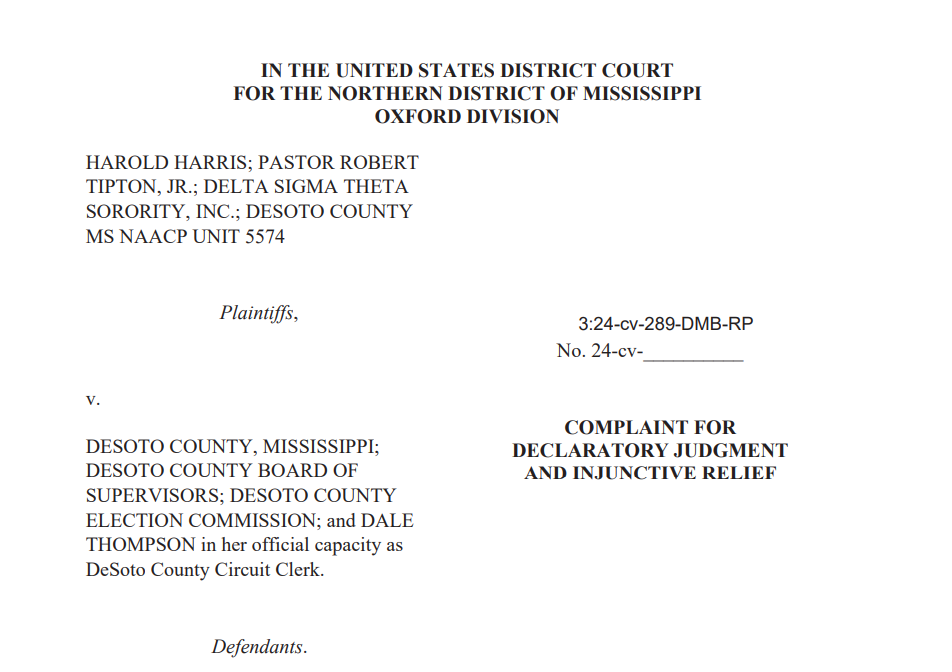
In Harris v. DeSoto County, plaintiffs argue that county redistricting from 2022 dilutes the power of Black voters. Since 2000, the population of the county has gone from being 12% to roughly 36% Black.
"More than 600 employees, only 13% of them are Black...in a county that's overall a third Black," said Amir Badat, one of the attorneys for the plaintiffs. "We heard testimony from witnesses who told us about going into the county courthouse, going into the county administrators building, going into all of these official county buildings and not seeing a single person who looked like them."
And, he argued, the electoral map compounds other issues in the county, describing the stories that plaintiffs have told in the courtroom for the last two weeks.
"A variety of different people, Black community members who have tried to run for election in the districts that are at issue here only to face all of the challenges that Black people are so familiar with facing in Mississippi when it comes to campaigning and trying to win elected office," Badat said. "Having their signs pulled up, facing intimidation and harassment when they're knocking on doors, having people yell racial slurs at them while they're trying to canvass and engage voters."
"All of these things that combine to make it incredibly difficult, combined with the way that the lines are drawn to make it incredibly difficult, and in DeSoto County, in many ways, impossible, for Black candidates to win and for Black voters to elect their candidates of choice."
Several other cases from Mississippi are examining whether certain lines are also discriminatory: one regarding some legislative districts may be considered by the U.S. Supreme Court, while one covering state supreme court districts has been appealed to the U.S. 5th Circuit Court of Appeals.
Another significant voting rights case, Louisiana v. Callais, is ongoing with the U.S. Supreme Court and could heavily effect voting rights across the country.
In the interim, Badat doesn't expect it to stop their current case in DeSoto, though.
"The court has on multiple occasions refused to delay this litigation to wait for the Supreme Court's decision in the Callais lawsuit, recognizing, I think, what everyone should recognize, which is that Section 2 has been upheld repeatedly by federal courts," said Badat. "The outcome of that case, of the Callais case, will have an impact, likely, on some of these other cases that are going on."
Plaintiffs in Harris v. DeSoto County include the DeSoto County chapter of the Mississippi NAACP as well as several community members from DeSoto County. Along with Badat, plaintiffs are represented by the Legal Defense Fund, the Election Law Clinic at Harvard Law School and the American Civil Liberties Union of Mississippi.
Delta Sigma Theta Sorority, incorporated, has also signed on as a co-plaintiff in the case. Their international president, Cheryl W. Turner, spoke to what they see at stake for Black communities in the county.
"When the map predetermined outcomes, as we all know, democracy is weakened," she said. "All five districts in this matter were drawn to maintain white majority populations and therefore no Black candidate has been elected from them in over 20 years."
And, Turner said, that heavily affects day-to-day life for folks in DeSoto County, especially with the local effects of county lines.
"It lands on persistent disparities in education, income, and health care," she said. "For example, white students make up less than 45% of the student population — yet all the school board officials are white in the DeSoto County community."
Those maps apply to the Board of Supervisors, Board of Education, Election Commissioners, Justice Court judges, and constables. While some elected officials in the county are Black, like Sheriff Thomas Tuggle and state Representative Rodney Hall, their positions are not affected by the electoral map in question.
Mike Hurst, attorney with Phelps Dunbar for the defendants, argued that the makeup of elected officials is due to party preferences, not issues with the map.
"The bottom line is this case is not about race, it's about politics," said Hurst, who apart from this case, also serves as Mississippi GOP chairman. "Democrats are mad they can't win an election in DeSoto County because it's a Republican County."
"Sadly, what this case about is mostly non-DeSoto Countians who are being aided by national Democratic special interest groups."
Hurst also thinks their case is pretty clear.
"I think in our case what the court will do is it will receive this evidence, it will review the evidence, and it will consider all of the evidence and find that DeSoto County did not violate the Voting Rights Act," Hurst said.
Badat feels much the same.
"We're really confident, in the facts that we presented to the court, we're really confident in our ability to meet the standard under Section 2, as currently articulated," Badat said. "We are feeling hopeful after having put on our evidence and having heard from so many community members who have told their stories in the courtroom."
"We obviously can't predict what the court will do or what the timeline will be, but we're hoping for a quick decision. "
A ruling for the plaintiffs could mean elections under new maps as soon as November 2026.