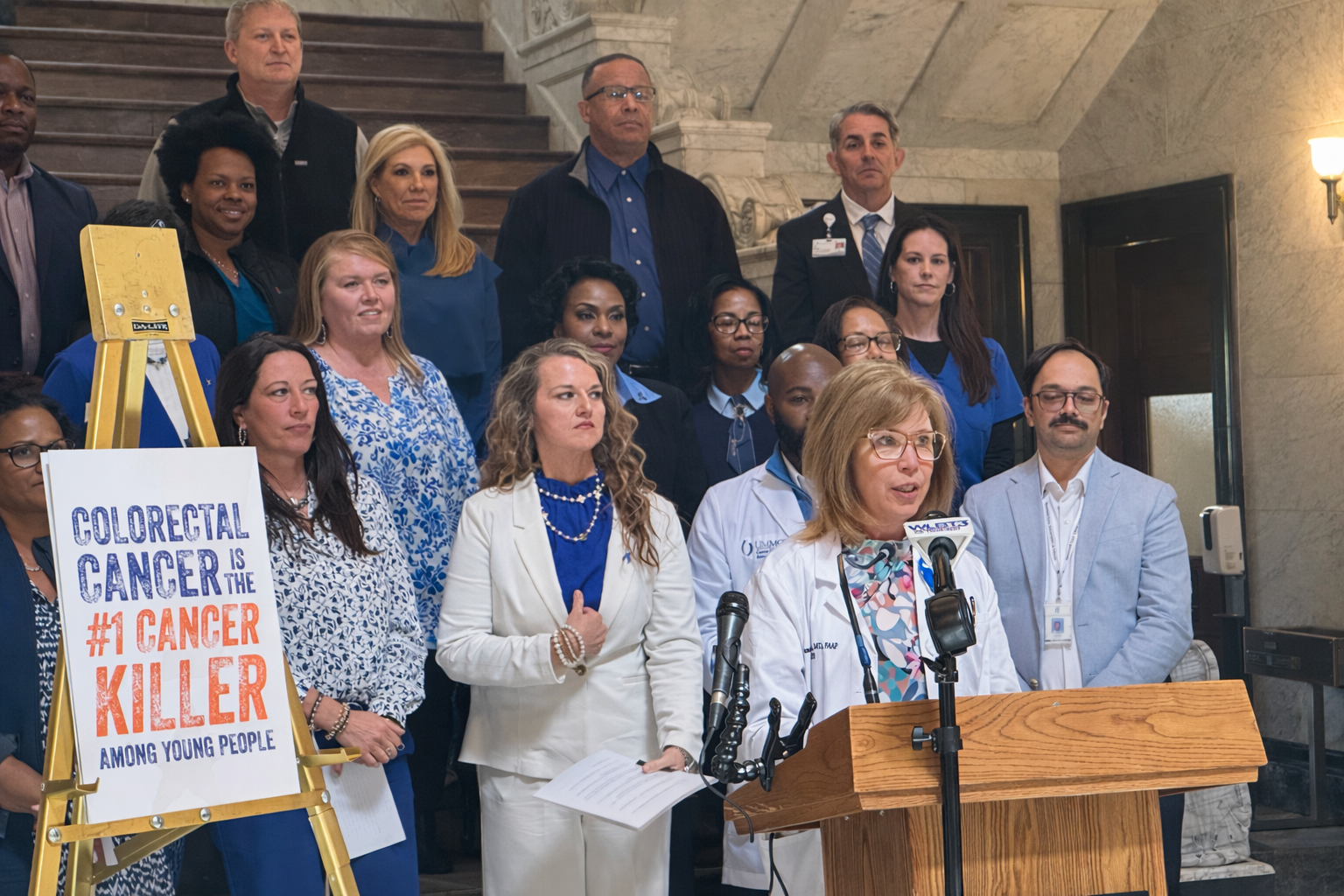
At a press conference in the Capitol marking Colorectal Cancer Awareness Month, speakers said Mississippi continues to carry some of the country’s worst colorectal cancer outcomes. From 2018 to 2022, more than 8,200 Mississippians were diagnosed with the disease and more than 3,100 died.
Mississippi Sate Department of Health medical director Dr. Tami Brooks said 663 Mississippians died from colorectal cancer in 2023 alone. She also said about 61% of cases in Mississippi are diagnosed at a late stage, when treatment is harder and survival rates are lower.
Speakers said many of those deaths could be prevented through screening, which can catch cancer early and, in some cases, stop it before it starts by finding precancerous growths.
The concern is especially acute in Mississippi, where screening rates still lag. One recent review put the state’s colorectal cancer screening rate at about 62.5%, below the national rate of about 66.9%. The same paper put Mississippi’s mortality rate at 17.6 deaths per 100,000 people, compared with 12.9 nationally.
Doctors at Monday’s event also pointed to a rise in cases among younger adults. Brooks said colorectal cancer is now the leading cause of cancer death nationally among adults younger than 50.
For Bryce Ramsey, a nurse from Canton, that warning was personal. Ramsey said she was diagnosed with colon cancer at 33 after initially brushing off symptoms. She later learned she has Lynch syndrome, a genetic condition that raises colorectal cancer risk.
“If you have one symptom, it may not be anything, but if you have more than one symptom that persists, don't let anyone tell you that you're too young to have cancer,” Ramsey said.
Dr. Justin Turner, community health officer at the University of Mississippi Medical Center, said one of the biggest dangers is that people assume they are healthy because they do not feel sick.
“The absence of symptoms does not mean the absence of disease,” Turner said.
Turner said about 70% of eligible Mississippians were screened in 2020, up from about 55% in 2014, but still leaving roughly 30% unscreened. Dr. Manju George, chair of the Mississippi Colorectal Cancer Roundtable, said screening rates among Mississippians ages 45 to 49 remain below 40%.
Brooks said the problem is not just a lack of awareness. In an interview after the press conference, she said many of the people missing screening are uninsured or facing transportation barriers that complicate access to colonoscopy and follow-up care.
“Access to care is one of our biggest barriers,” Brooks said. “We do have an uninsured adult population, who are often working so they can't take off work.”
Research on colorectal cancer in Mississippi points to broader structural problems behind the state’s rates, including high poverty, lower insurance coverage, provider shortages and long travel distances for care. One paper notes that all 82 Mississippi counties are considered medically underserved and that some Delta residents may have to travel about 75 miles to reach basic health services.
Brooks said the Mississippi State Department of Health and its partners are trying to expand access through mail-out stool tests, which can be done at home and detect blood or abnormal DNA in stool.
Amy Ellis with the American Cancer Society said colonoscopy remains the gold standard, but described getting people into any screening pipeline as a critical first step.
“The best test is the one that you're going to do,” she said.