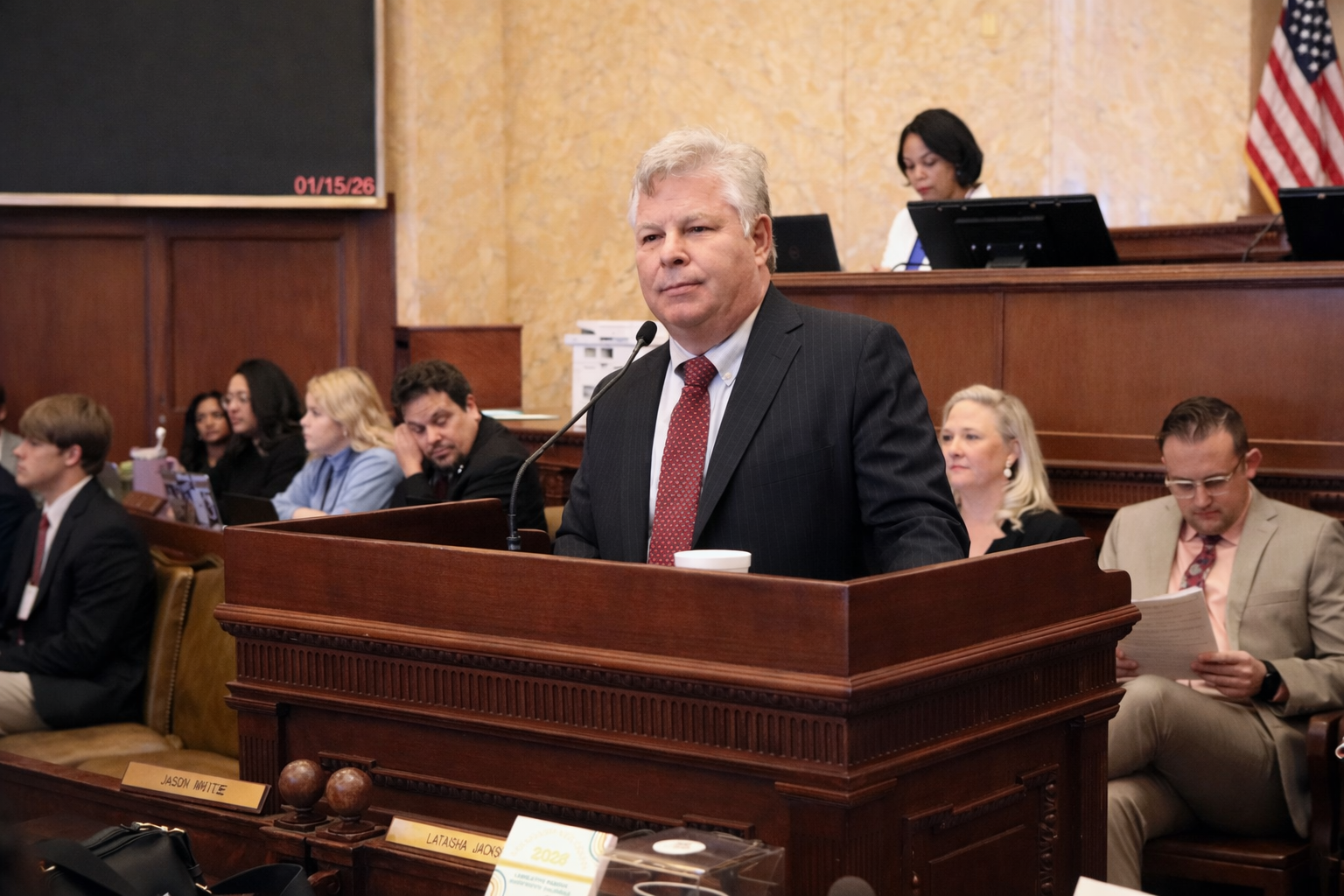
House Speaker Jason White’s “Education Freedom Act” passed the chamber by a razor-thin 61–59 vote, underscoring deep divisions over the future of public education in Mississippi. Seventeen Republicans joined Democrats in voting against the bill.
If enacted, the legislation would dramatically expand school choice in the state, allowing thousands of families to use public education dollars for expenses like private school tuition, tutoring or homeschooling. The more than 400 page bill also rewrites public-school transfer rules and loosens restrictions on charter schools.
Rep. Celeste Hurst, R-Sandhill, opened the debate by defending both the scale of the bill and its underlying premise: parents should have more control over their children’s education.
Supporters opened the debate by defending both the scale of the bill and its underlying premise: parents should have more control over their children’s education.
“You don't turn around decades of government mandates, bureaucratic red tape, failing schools, and rigid regulations with a five page bill,” Hurst said.
Democratic lawmakers spent much of the debate questioning whether the bill’s promise of choice would translate into real access for families in practice.
House Minority Leader, Rep. Robert Johnson, D-Natchez, argued new education spending should be directed to the system that has to serve every child in Mississippi, rather than a school choice program that could only benefit a small fraction of them.
“The truth is, it does not provide access to every child, but it provides a mechanism where you can try,” Johnson said.
Supporters repeatedly argued that the existing system already fails many students, and that expanding options gives families a way out when schools are not meeting their children’s needs.
“Supporting school choice doesn’t mean turning backs on public education. It means opening our eyes to the reality that every baby is unique and every baby is different,” Rep. Janen Owen, R-Poplarville, said.
Democrats also argued affluent families would be better positioned to take advantage of the flexibility offered by the school choice program. Rep. Jeffrey Hulum III, D-Gulfport, pointed to the absence of transportation funding as an example of barriers that could prevent low-income families from even applying.
“How will the people who are working two and three jobs, they barely make ends meet, how will they get their kids to another district?” Hulum said.
Others questioned the lack of oversight for private schools receiving public funds under the program, pointing to the accountability standards public schools are held to. Owen, in turn, framed school choice as a form of accountability driven by parents, rather than regulation.
“One very big penalty is mama and daddy says you’re failing my student right now and I’m going somewhere else,” Owen said.
House Education Chairman, Rep. Rob Roberson, R-Starkville, conceded during the debate that some of the concerns raised by Democrats were legitimate, but argued they were not reason enough to stop the bill.
“There’s no such thing as 100% positive legislation,” Roberson said. “ I don’t think either of us have ever voted on a bill that was perfect.”
Roberson framed the version of the bill being taken up as a starting point rather than a finished product, suggesting changes could be made as the bill continues through the legislative process.
In the final stretch of debate, the House considered a series of Democratic amendments aimed at narrowing or reshaping the bill. Lawmakers rejected seven of those proposals, including measures that would have added transportation funding, placed accountability standards on private schools, or even replaced the bill entirely with a proposal focused on teacher pay raises.
After passage, the bill was held on a motion to reconsider, a procedural step that allows the House to revisit the measure and make additional changes before formally sending it to the Senate.