In a 6-3 ruling Wednesday in Louisiana v. Callais, the Court struck down a Louisiana congressional map that created a second majority-Black district, finding it amounted to an unconstitutional racial gerrymander. The decision does not eliminate Section 2 of the Voting Rights Act, but it raises the bar for challengers seeking to prove that political maps unlawfully dilute minority voting strength.
The ruling lands as Mississippi lawmakers are preparing to redraw the state’s Supreme Court districts. Gov. Tate Reeves called a special session last week, scheduling lawmakers to return 21 days after the Court issued its decision in the Louisiana case.
That timing was no accident. State attorneys had asked U.S. District Judge Sharion Aycock to delay any new Mississippi Supreme Court map until the Court ruled in Callais, arguing the decision would likely shape what lawmakers and courts could do next.
Aycock ruled last year that Mississippi’s current Supreme Court districts violate the Voting Rights Act because they do not give Black voters a fair opportunity to elect candidates of their choice. The Legislature was given time to redraw the districts during the 2026 regular session but adjourned without passing a new plan.
The Supreme Court’s decision now gives Republicans a stronger argument that the state’s current maps can survive legal scrutiny.
Mike Hurst, chairman of the Mississippi Republican Party, said he believes Mississippi’s current Supreme Court districts are now legally defensible based upon the decision in Callais.
Hurst also praised the ruling as a “monumental decision” and “a huge win for race-neutral government action.”
The majority opinion said Section 2 claims must show a strong inference that a state intentionally gave minority voters less opportunity because of race.
Supporters of the ruling say it prevents courts and interest groups from using the Voting Rights Act to force states to draw race-based districts. Reeves called the decision “a win for our Constitution and a tremendous win for our republic.”
“It was long past time to end racial redistricting,” Reeves said in a statement. “Today’s decision reaffirms what we knew all along: that all Americans, regardless of race, are equal.”
Critics of the ruling say courts cannot address racial discrimination in voting by pretending race is irrelevant.
Jade Craig, an assistant professor at the University of Mississippi School of Law, says the promise of a colorblind system ignores the need to enforce the Fifteenth Amendment’s prohibition of racial discrimination in voting.
“Just talking about race doesn’t make something racist,” Craig said. “So in order to deal with it, we have to deal with the problem of race. And we can do that in ways that are fair and effective for everybody.”
State Auditor Shad White, a likely Republican candidate for governor in 2027, said the ruling could open the door to redrawing Mississippi’s congressional districts. White wrote on X that Mississippi “might no longer have a district drawn to protect Bennie Thompson.” State Sen. Kevin Blackwell, R-Southaven, said it was time to “erase” Thompson’s district.
Thompson, Mississippi’s lone Democrat and only Black member of Congress, called the ruling a “direct assault on the voting rights movement.”
“The decision also dishonors the legacy of voting rights activists, some of whom paid the ultimate sacrifice for citizens of our state to have equal representation and to participate in fair elections,” Thompson said.
Democratic lawmakers and civil rights groups in Mississippi warned the decision could give Republican-led states more room to redraw maps in ways that diminish Black voting power.
Senate Minority Leader Derrick Simmons, D-Greenville, said the ruling could “open the door for states to redraw congressional districts in ways that may dilute minority voting strength and reshape political power ahead of future elections.”
The Mississippi State Conference NAACP said the ruling will make its voting rights work harder. Charles V. Taylor, the group’s executive director, said the decision restricts tools used to ensure fair representation for Black communities.
“This is clearly not about fair representation rather sacrificing the voices of Black Mississippians for political gain,” Taylor said in a statement.
Mississippi Votes called the ruling “a dangerous step backward” and said it weakens protections against the dilution of Black voting power.
“In Mississippi, we know what is at stake when our voices are silenced,” said Lily Moens, the group’s policy and research director. “This moment demands action.”
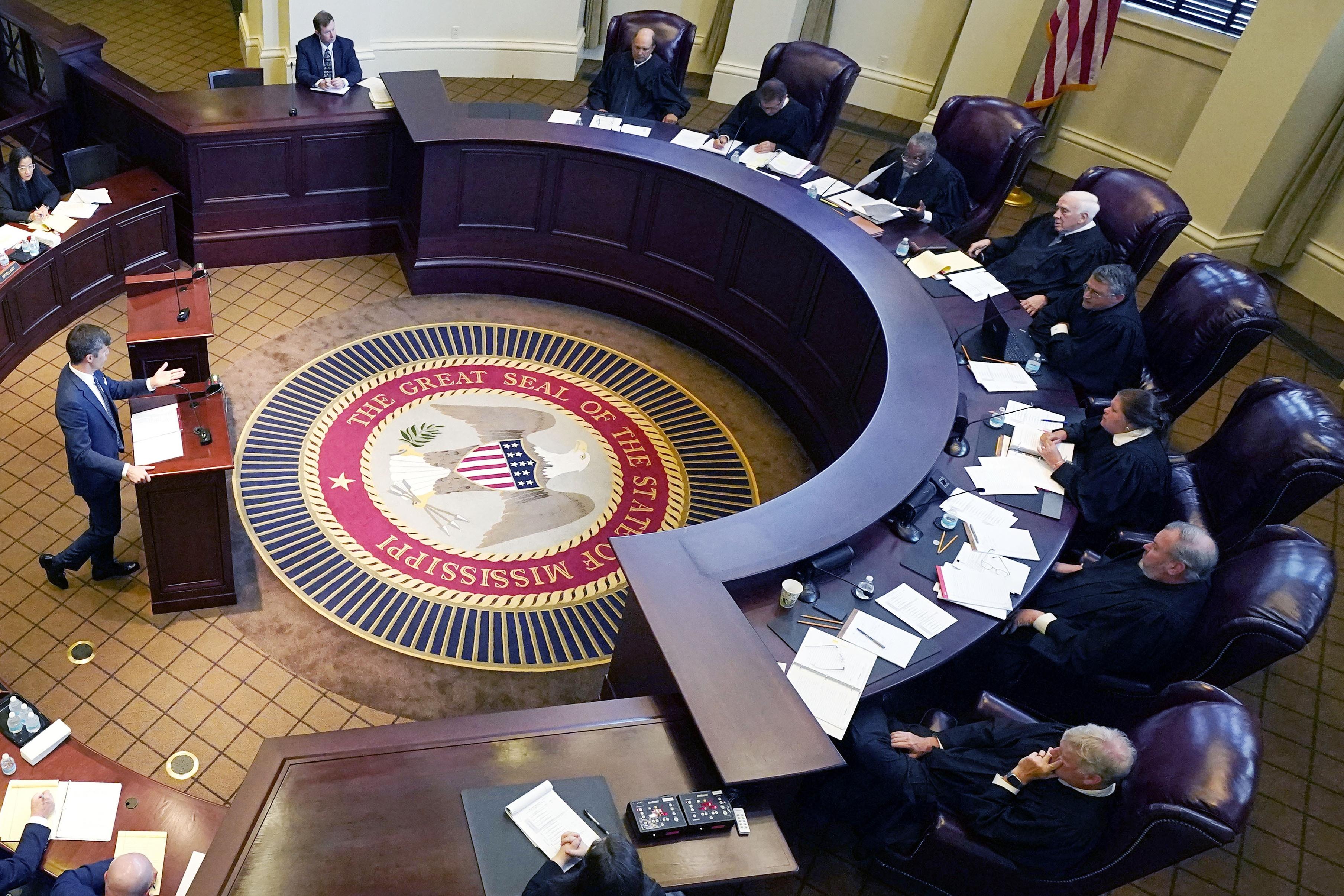
But the immediate legal fight in Mississippi is over the state Supreme Court, not Congress. The state legislature could be among the first to act under the new legal standard for redistricting if the special session is held as planned.
Mississippi’s nine justices are elected from three districts. The Central District, which is at the center of the federal lawsuit, includes much of the majority-Black Delta and the majority-Black Jackson metro area.
Mississippi has the highest percentage of Black residents of any state. But no Black person has ever been elected to the Mississippi Supreme Court without first being appointed by a governor, and no Black person from the Northern or Southern districts has ever served on the state’s high court.