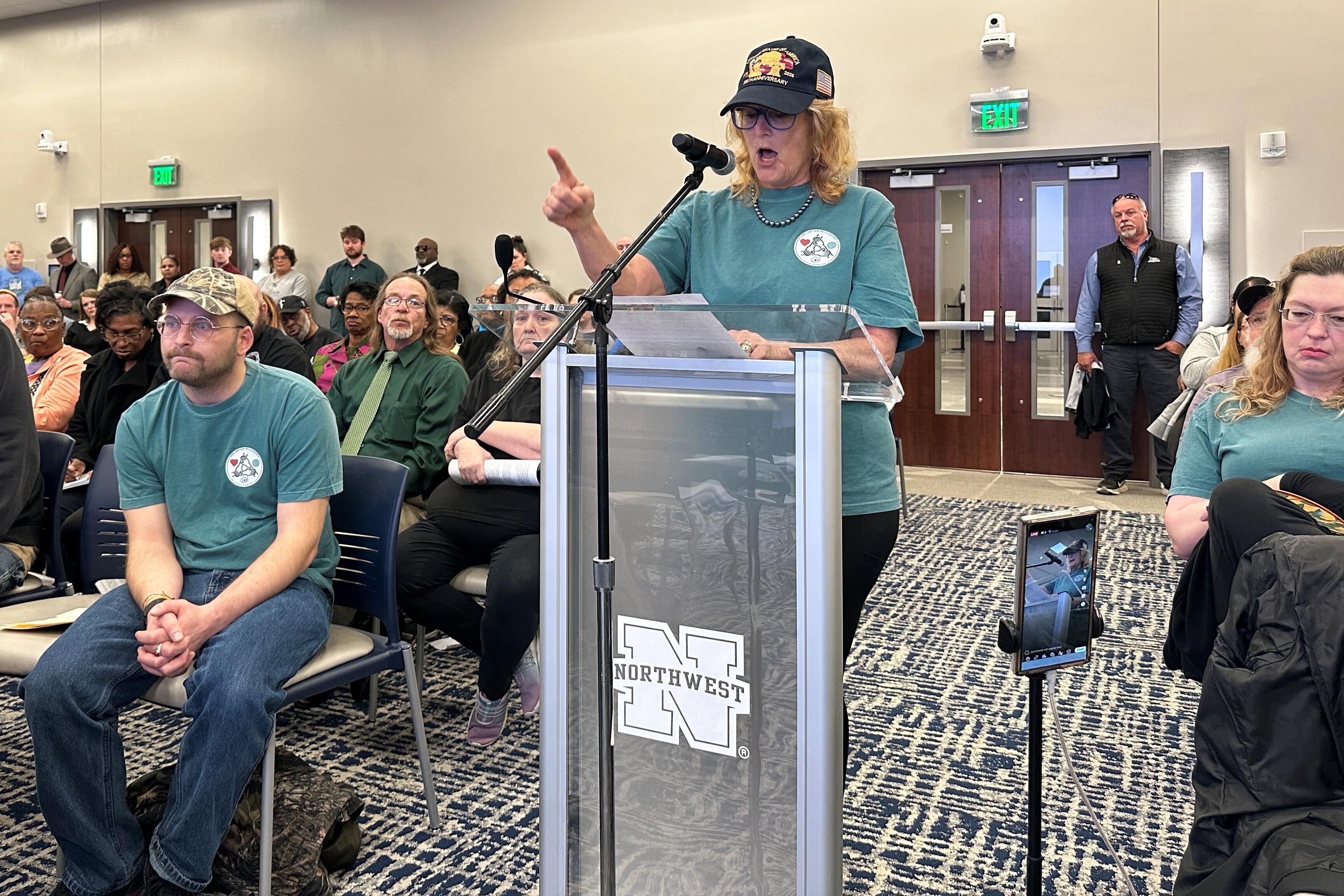
State regulators have approved a key environmental permit allowing Elon Musk’s artificial intelligence company xAI to expand its natural gas power plant in Southaven, a move that residents say could worsen noise and pollution in surrounding neighborhoods.
The Mississippi Environmental Quality Permit Board voted unanimously Tuesday to approve the company’s application to install 41 permanent natural gas turbines at the site.
Jaricus Whitlock, an air permit manager with MDEQ’s Office of Pollution Control, said air quality modeling showed emissions from the turbines would remain within federal and state pollution standards.
Under federal air permitting rules, regulators must approve projects that meet pollution standards, even if nearby residents oppose them.
But that’s no comfort for people living near xAI’s power plant. Several Southaven residents said the 27 mobile turbines currently operating at the site have produced a constant low hum that can be heard both outside and inside nearby homes.
Jason Haley lives about half a mile from the power plant and says the noise has been present around the clock since August.
“That's just been daily life, man. You hear it inside your house. You step outside, you hear it. It sucks,” Haley said.
The turbines are part of a power system supporting the company’s computing facility in Memphis that xAI says contains the world’s largest AI supercomputer.
Brent Mayo, vice president of operations at xAI, says the company’s broader project represents billions of dollars in investment and could help establish the region as a hub for AI infrastructure.
“We've already created thousands of well-paying jobs in construction, engineering, and operations that support local families and strengthen the regional economy,” Mayo said.
Mayo addressed the permit board during Tuesday’s hearing but declined to speak with reporters afterwards.
Some residents and advocacy groups urged regulators to deny the permit, raising concerns about both pollution and noise from the turbines.
Community organizer Shannon Samsa said many impacted residents only realized the scale of the project after construction had already begun.
“If this was truly a great facility, there were no problems, nothing wrong, we would have had a voice in this,” Samsa said.
She and other residents say the permitting process moved too quickly and left neighbors feeling their concerns were secondary to the project’s economic promise.
Some also criticized how the hearing was scheduled. The meeting was held at MDEQ’s office in Jackson on the same day as Mississippi’s primary elections, roughly three hours from DeSoto County where the xAI project is located. Opponents said the timing and location made it difficult for more affected residents to attend and speak.
“MDEQ claims that the scheduling is business as usual, but the reality is that these decisions create barriers that prevent meaningful community participation,” said Nsombi Lambright-Haynes,who spoke as a representative of the Jackson NAACP.
Haley said the experience has made him question whether he can remain in the house he has lived in for two decades.
“I know a lot of my neighbors and the community but I really don't feel like I'm going to have much of a choice but to get out of there. I mean just for my own sanity,” Haley said.
If the turbines are built as planned, the power plant would be capable of generating enough electricity to power a mid-size city.
Environmental groups that opposed the permit say they are reviewing the decision and considering possible legal challenges.