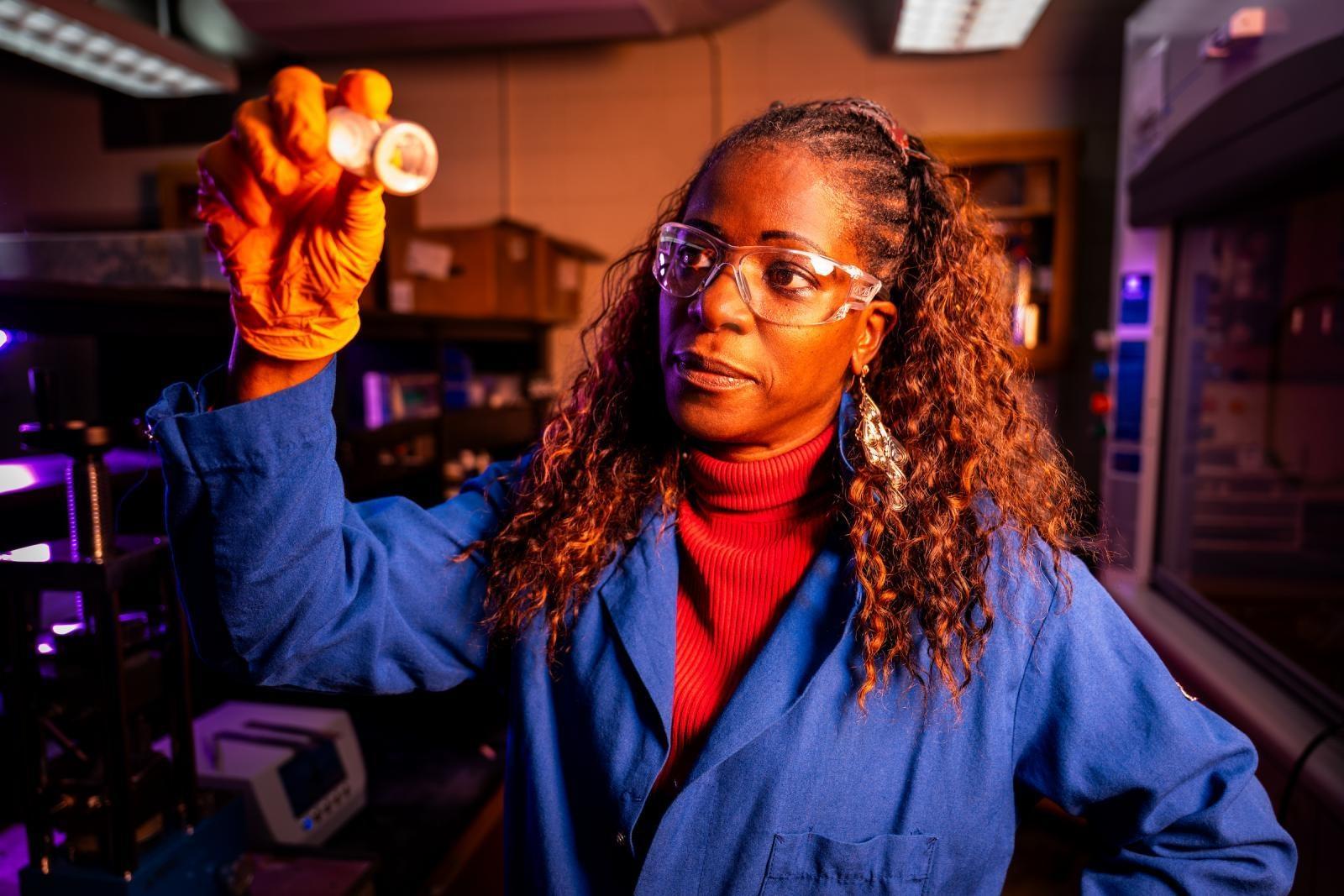
“I got an email saying that the office of Congresswoman Cindy Hyde-Smith had asked about several intellectual properties that came out of the state, and they had chosen my intellectual property work,” said Scott, an MSU associate professor of chemistry.
While Scott said her work is still in development, she is being recognized for her team’s discovery of a new class of shortwave infrared (SWIR) imaging dyes.
“We have some data, but we're still working on some more data. And it involves us trying to detect cancer cells selectively,” she said. “The reason is that we want to be able to differentiate normal cells from cancer cells.
Scott’s technology aims to accurately determine the boundaries of cancerous tumors in deep tissue, something she believes surgeons have long struggled with.
“It's like a mountain, right? So when you get to the bottom, how do you know where it actually stops because it blends right into the valley,” she said.
Surgeons will often cut into extra tissue around tumors, trying to extract dangerous residual cells, following these interventions with chemotherapy or radiation therapy. It’s not a failproof system.
“If they miss cells, those cells can regrow and they tend to be more aggressive when they come back,” said Scott.
Her technology uses special dyes injected into deep tissue and low infrared rays to specifically detect cancer cells without surgically cutting into patients. Currently, CT scans and PET scans can look for tumors, but may not be able to accurately analyze the full boundary of a tumor. Currently, surgeons have been applying stains directly to tissue, but remaining cancer cells may still be hard to detect after intervention efforts and treatment.
“Either they missed it in the original treatment or it had already metastasized and spread. They just don't have a way to detect it at the moment until it starts growing back, and then by that time it's too late,” said Scott. “So, we just need a better way of seeing them.”
Because cancer cells tend to be more acidic than normal cells, Scott said medical professionals should be able to literally see where cancer cells are clustered.
“Cells that don't have [a normal cell’s] pH range, they should not respond to the dye,” said Scptt. “So you don't see it. Even if the [normal] cell uptakes the dyes, which we expect them to do, they won't shine, they won't light up.”
Dr. Scott, who is originally from Kingston, Jamaica, has been working on this technology since 2006, when a colleague and mentor at Southern Illinois University in Carbondale introduced her to the use of dyes. However, that scholar passed away from brain cancer in 2009.
“Even after surgery and chemo and radiation and everything, [they] eventually passed away from the disease,” said Scott. “So I felt like, wow, it's an important area and I need to learn more and I need to look into this more.”
Scott said she fell in love with the potential of the dyes in detecting cancer cells.
“Everybody understands the devastation of cancer,” said Scott. “Anything we can do to help anyone to have a better prognosis when they're diagnosed with this disease, you have to try. You have to keep working at it.”
The chemist attributes her move to Mississippi to the major shift in her work.
“When I moved to Mississippi State, that's when it opened up more opportunities for me,” she said. “We got an award that focused on looking at how light interacts with a lot of different surfaces and media. And that collaboration really extended my approach to now looking at guys in the SWIR region.”
Scott found that the dyes may be useful for other health issues as well, such as detecting liver diseases. But she emphasizes her work is still in progress.
“You still would probably have to do biopsies and check. But for surgery itself, it just also gives the surgeons a little bit more information on where the boundaries are so they can even cut beyond that,” she said. “So, it's not easy and we're not there yet. We're somewhere along the path.”
Her team is small. An MSU student currently makes the dyes and a collaborator at Albany Medical Center in New York state tests cells. Scott is hoping to expand her team soon to move forward more quickly.
“We need a bigger team to really address this and move more efficiently or faster,” said Scott. “My team has always been small, so it has been very slow going.”
She will receive her award at a special event held between June 3 - 4 in Washington, DC.