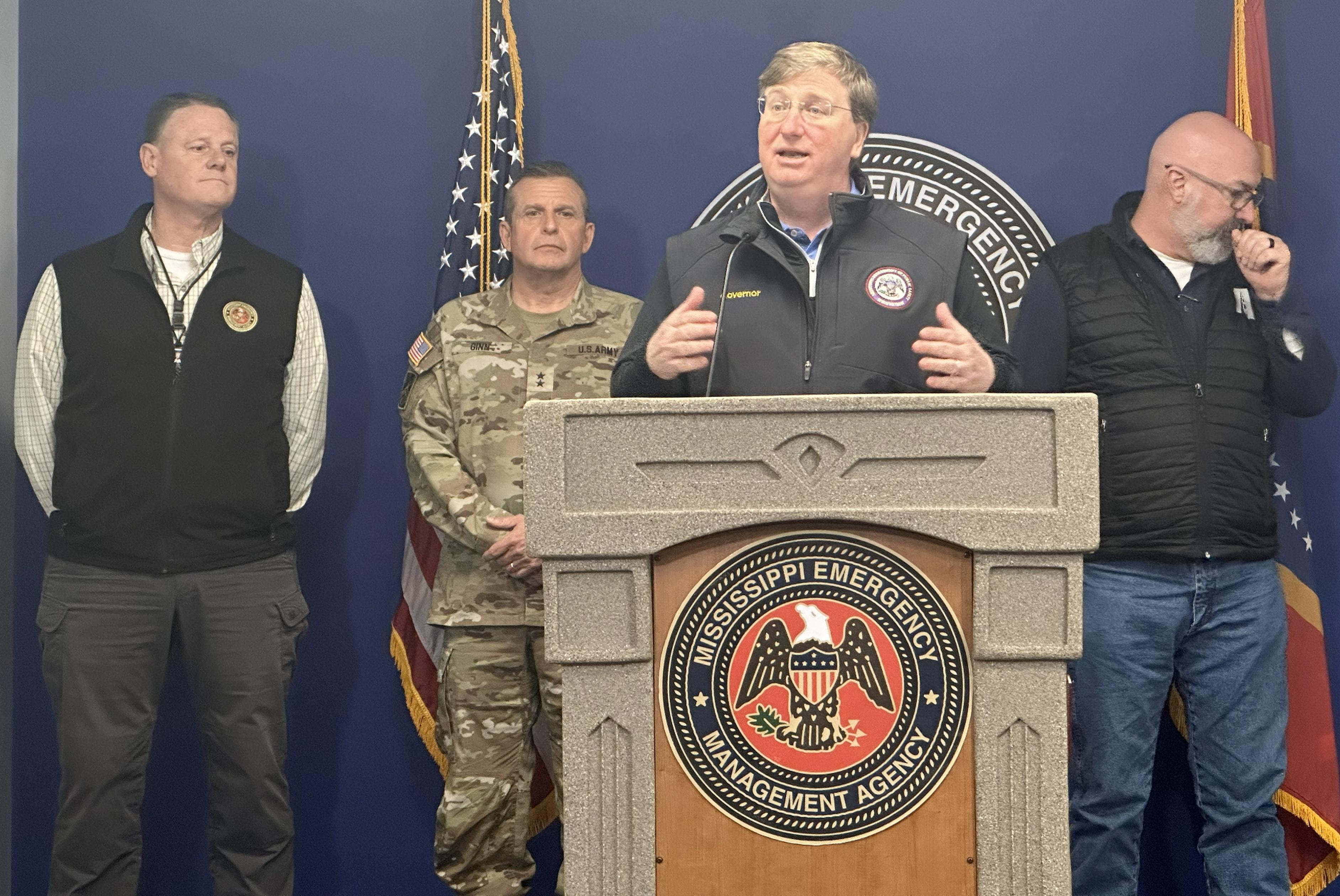
Reeves announced the deployment Monday, saying Guard members will help move generators, fuel, and other emergency supplies into hard-hit communities, particularly in north Mississippi, where ice has remained locked in place for days.
“We will get through this, but we're not gonna get through it today and we're not gonna get through it tomorrow,” Reeves said. “This is going to take time.”
Reeves emphasized that National Guard members will focus on logistics and supply delivery, not power restoration itself, which remains the responsibility of utility crews. Bringing in mutual-aid linemen from other states has swelled that workforce to roughly 2,500 linemen, according to Entergy Mississippi CEO Haley Fisackerly
Major General Bobby Ginn Jr., adjutant general of the Mississippi National Guard, said the Guard expects to be fully mission-capable by midweek, with units staged out of Camp McCain and other locations to support local emergency managers.
Emergency management officials say the challenge is no longer precipitation, which has moved out of Mississippi, but prolonged subfreezing temperatures that have limited access for emergency responders, transportation crews and utility workers.
At the peak of the storm, Mississippi accounted for more than 20 percent of power outages nationwide. As of midday Tuesday, roughly 143,600 customers were without power, down from a high of about 180,000, according to Reeves. State officials have confirmed three storm-related fatalities.
Poor road conditions remain one of the biggest bottlenecks in restoring power and delivering aid.
Brad White, executive director of the Mississippi Department of Transportation, said crews have focused on keeping major routes open while also clearing fallen trees and power lines.
“Our goal has been to keep the interstates, the four lane highways, the major two lane highways passable,” White said. “And I point out that word passable. That’s a lot different from saying it’s safe.”
White told reporters that MDOT crews have logged tens of thousands of work hours since the storm, treating thousands of lane miles and bridges across north Mississippi and the Delta. He said ice cannot be plowed like snow and that sunlight and temperatures above freezing will ultimately be the most effective tools for clearing roads.
Officials continue to urge residents to avoid unnecessary travel so crews can reach damaged areas more quickly and safely.
The Mississippi Highway Patrol says traffic volumes initially dropped as the storm hit, but troopers are seeing more drivers venture out as roads appear to improve.
Bryan McGee, a northern region supervisor with the Highway Patrol, said that overconfidence remains a major risk.
“Even though you think, ‘Hey, I’ve got a truck. It’s in four wheel drive,’” McGee said, “if all four tires are slipping, that’s not helping you any. So take it slow.”
McGee said crashes and stranded vehicles continue to divert emergency resources, particularly on secondary and rural roads where ice lingers longer and sunlight is limited.
Utility officials say damage assessments are still underway and that restoration will not be uniform across the state.
During a separate press conference, Entergy Mississippi officials said they had assessed less than half of the damage statewide as of Monday afternoon. Restoration timelines vary by region, with central and southern Mississippi expected to see earlier progress and parts of north Mississippi facing longer outages.
Utility officials said some areas in the north, including the Grenada region, could remain without power into the weekend, depending on road access, continued assessments and weather conditions.
“The power will not be restored quickly. It will be restored safely,” De'Keither Stamps, Central District commissioner on the Mississippi Public Service Commission, said. “When a lineman is injured, that means only another lineman can come help him before emergency services can respond.”
State leaders continue to urge residents in heavily impacted areas to stay home if possible, check on neighbors and utilize warming centers if they are without heat.