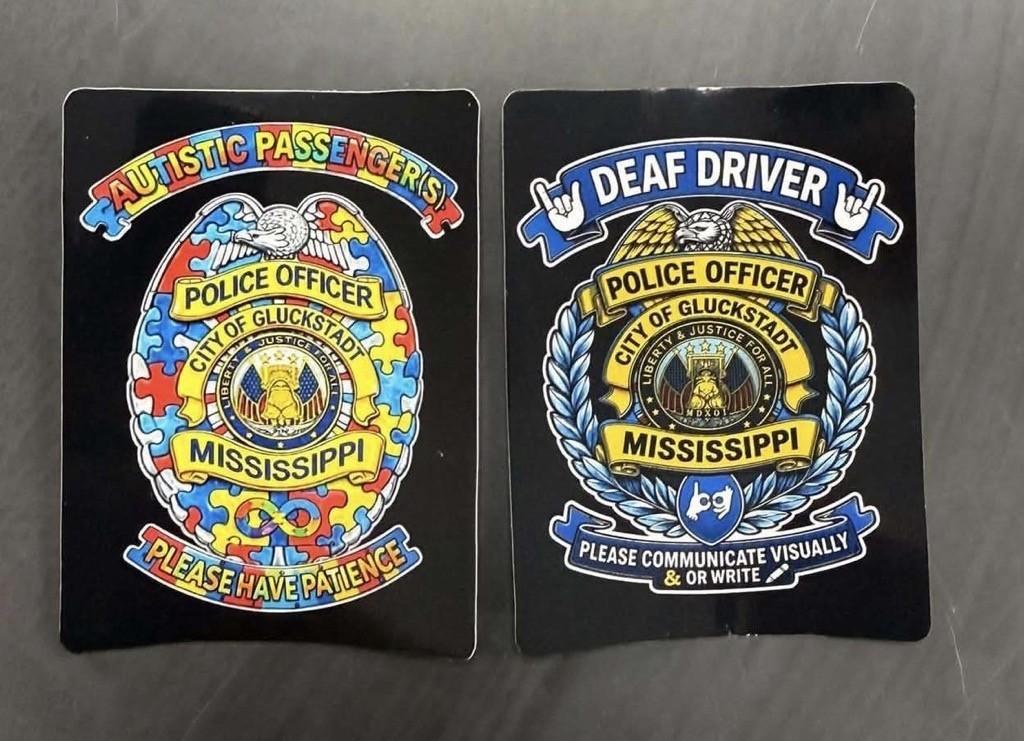
The Gluckstadt Police Department recently introduced free vehicle stickers for residents who are deaf, hard of hearing, or on the autism spectrum. The decals are intended to alert officers before they approach a vehicle, allowing them to adjust communication methods and responses during traffic stops or other encounters.
What began as a local initiative has quickly gained interest from agencies and residents across the country. Police Chief Barry Hale said departments and individuals from multiple states have contacted Gluckstadt seeking information on how to launch similar programs.
"We've had people reach out to me from Georgia, Virginia, Kentucky, Maryland, Alabama wanting stickers," Hale said. "We're not trying to keep all this to ourselves."
The concept for the autism sticker was born after Sgt. Kyrie Lucas conducted a traffic stop involving a mother whose autistic child repeatedly removed his seat belt. Lucas said the encounter made him realize officers often have little information about disabilities before approaching a vehicle.
"She told me her son was autistic and wouldn't keep the seat belt on," Lucas said. "I started thinking about situations like that and how officers could better understand what they're walking into."
After discussing the idea with his wife, Lucas designed a sticker to identify vehicles carrying individuals on the autism spectrum. Chief Hale approved the project, and the department began distributing the stickers free of charge. Soon after, Dispatch Supervisor Kristen Baker proposed a second sticker specifically for deaf and hard-of-hearing drivers.
The community response exceeded expectations. Hale noted the department initially ordered 100 autism stickers, then 200 more, followed by subsequent rounds as demand continued to climb.
While advocates and families welcome the stickers as an important first step, they emphasize that specialized training for law enforcement is equally critical. Adam Wells, a Gluckstadt resident and father of a 16-year-old son with autism, said the stickers are only effective when officers understand associated behaviors.
One specific example is "stimming," which refers to repetitive movements that help some autistic individuals regulate sensory input or emotions.
"My son may hand flap or make sudden movements," Wells said. "My son might even hit at you. Because certain noises really make him hurt. If he does that to an officer who isn't trained, we're looking at a tragedy."
Wells has since received messages from people nationwide asking for the stickers, but he remains firm that training must accompany the visual aids. "The whole thing is the officer sees the sticker and remembers that person may be nonverbal, may not respond to commands or may stem," he said. "The stickers really don't mean anything if the training doesn't go with it."
Matt Nalker, executive director of The Arc of Mississippi, agreed that stickers serve as vital awareness tools by providing context before an encounter begins. "If they have a little more information, it's always going to lead to a better outcome," Nalker said.
"If they have a little more information, it's always going to lead to a better outcome," Nalker said.
Nalker, who is also the parent of an adult son on the autism spectrum, cautioned officers against making assumptions based solely on a diagnosis. "Don't assume because you've met one person with autism that you've met all people with autism," he said.
"Don't assume because you've met one person with autism that you've met all people with autism," he said.
Communication barriers create similar challenges for the deaf community. Jackson resident Annabeth Reed, who is deaf, recalls a fearful encounter during a traffic stop several years ago where she struggled to understand an officer speaking too quickly.
"I felt fear because I couldn't understand the officer," Reed said. "I wish he knew sign language or had another way to communicate."
Reed believes a sticker would have signaled the need for a different approach. "There are people that don’t speak, and they can’t hear," she said. "And you don’t know how to talk to cops. That’s a big problem."
Kathryn Warren, a sign language interpreter and autistic adult living in Clinton, noted that the initiative acknowledges disabilities that are not always visible. "Something you may not be able to see with the naked eye can change the way someone interacts during a police encounter," Warren said.
"Something you may not be able to see with the naked eye can change the way someone interacts during a police encounter," Warren said.
She described the stickers as the "first step in a long line of steps" needed to support Mississippians with disabilities, advocating for standardized training across all departments.
"There needs to be across-the-board information that every officer can use when interacting with individuals with disabilities," Warren said.
Chief Hale acknowledged that agencies across the state would benefit from expanded training. He cited Crisis Intervention Team (CIT) training as a potential model. "Anything that can help with law enforcement and help somebody from getting hurt because of a lack of communication or lack of training is worth it," Hale said.
Advocates and officials alike hope state leaders will consider implementing disability-awareness training throughout Mississippi's police academies. For Sgt. Lucas, the goal remains simple: creating safer interactions.
"We're here to serve the public," Lucas said. "If we can help people and bring awareness one sticker at a time, then that's what it's all about."