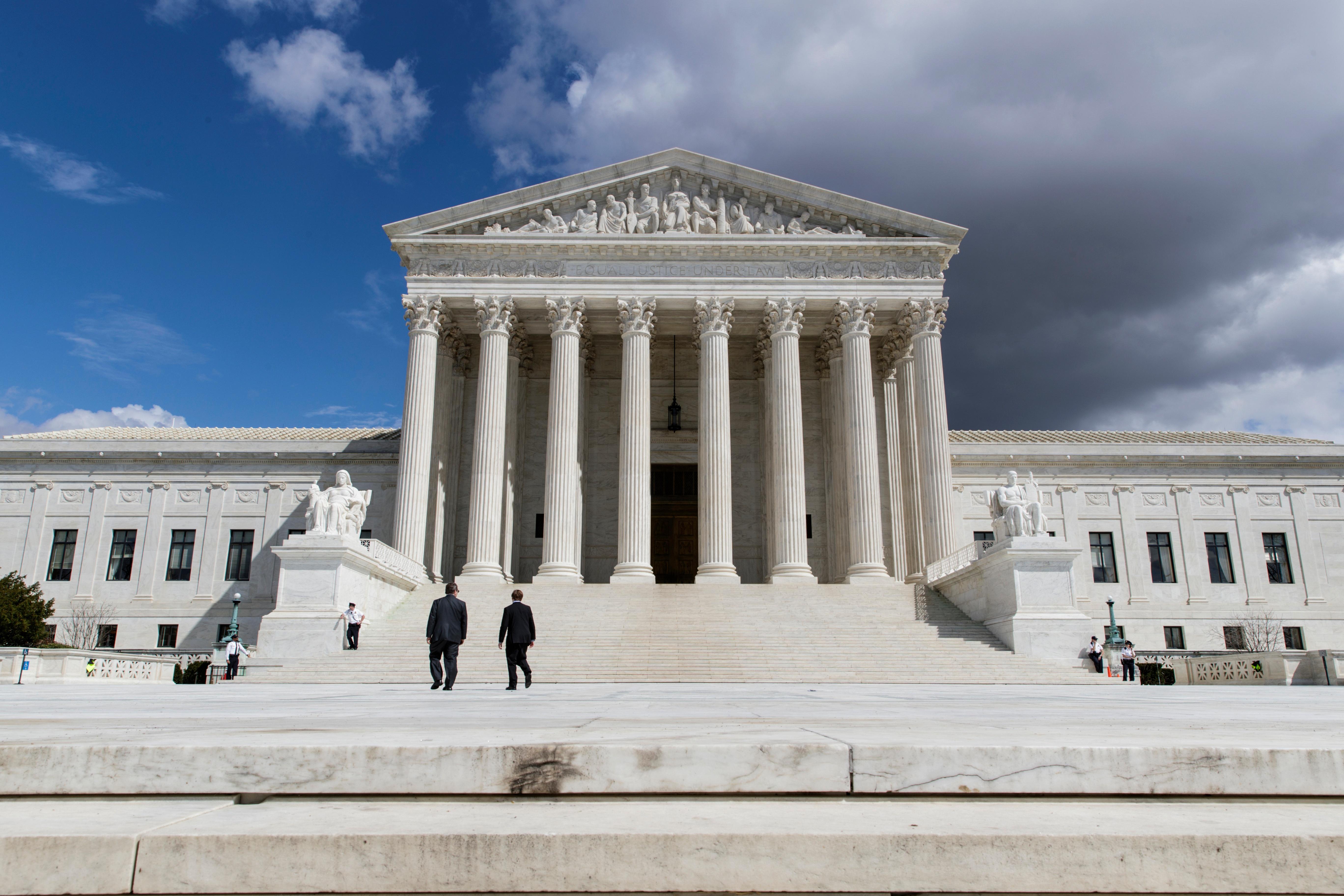
But the 5-4 decision does not decide whether prosecutors intentionally discriminated during jury selection. It also does not automatically grant Pitchford a new trial.
Pitchford was sentenced to death for his role in a 2004 grocery store killing near Grenada. He and Eric Bullins robbed a grocery store, and Bullins shot and killed the store owner. Bullins reached a plea deal and received a 20-year sentence, while the state charged Pitchford with capital murder and sought the death penalty.
The issue the Supreme Court reviewed began during jury selection at Pitchford’s trial. Prosecutor Doug Evans used peremptory strikes against four of the five Black prospective jurors. The jury that convicted Pitchford had 11 white jurors and one Black juror.
Under the Supreme Court’s 1986 ruling in Batson v. Kentucky, prosecutors cannot strike jurors because of race. Courts use a three-step process to evaluate those challenges. First, the defense must make an initial showing that a strike may have been based on race. Second, the prosecutor must give a race-neutral reason. Third, the defense gets a chance to argue that explanation is not the real reason, and the judge decides whether the strike was discriminatory.
Pitchford’s lawyers argued that third step never happened.
Attorneys for the state argued Pitchford’s trial lawyer did not rebut Evans’ explanations during jury selection and that the Mississippi Supreme Court reasonably treated later pretext arguments as waived. The Supreme Court’s majority rejected that reading of the trial record.
Writing for the majority, Justice Brett Kavanaugh said the trial judge accepted Evans’ explanations as race-neutral but did not give Pitchford’s lawyer a sufficient chance to challenge whether those explanations were the real reasons for the strikes.
“In this case, whether due to confusion, oversight, an overly hurried jury selection process, or some other cause, things broke down, and the ordinary trial-court procedure for resolving Batson claims at step three never occurred,” Kavanaugh wrote.
The majority said federal courts owe deference to state court decisions in habeas cases. But Kavanaugh wrote that “deference does not mean abdication,” and the Mississippi Supreme Court unreasonably concluded Pitchford had waived his chance to challenge the prosecutor’s reasons.
Justice Neil Gorsuch saw the trial transcript differently. He said Pitchford’s attorneys were able to speak up at other points during jury selection and argued the record did not clearly show they were prevented from challenging Evans’ explanations.
“Mr. Pitchford’s account of a muzzled defense team is hard to square with the record,” Gorsuch wrote.
Gorsuch was joined by Justices Clarence Thomas, Samuel Alito and Amy Coney Barrett in the dissent. It said the Mississippi Supreme Court had a reasonable basis to conclude Pitchford raised the issue too late. But Gorsuch also acknowledged the ruling’s impact is limited because the majority did not decide whether Pitchford is entitled to a new trial.
Tucker Carrington, director of the George C. Cochran Innocence Project at the University of Mississippi School of Law, said the ruling reinforces that judges must do more than accept a prosecutor’s explanation at face value.
“Without the court taking a step back to assess, Batson would have no effect because any lawyer could just say, ‘oh, here's my race neutral reason. You have to accept it. Let's move on,’” Carrington said.
Carrington also filed a friend-of-the-court brief for the Mississippi Legislative Black Caucus supporting Pitchford.
Doug Evans also prosecuted Curtis Flowers, whose conviction and death sentence were overturned by the Supreme Court in 2019 after finding racial discrimination in jury selection. Carrington said Pitchford’s case showcases systemic issues larger than one prosecutor or judge.
“There are sort of fundamental systemic problems with the way trial and appellate courts in Mississippi are understanding Batson and applying Batson,” Carrington said. “Batson has three steps. Not one and two, not one and three, not two and one, one, two, and three. And three is important. It can’t be history blind.”
Merrida Coxwell, a longtime Mississippi defense attorney who has handled roughly two dozen death penalty cases, said the ruling is narrow but the rights at stake are not.
“If one person says, ‘I don't care what the government says, I want to go to trial,’ he has to be afforded every right that the person sitting in their rocker who will never be charged with a crime has but doesn't exercise,” Coxwell said. “It just can't be any other way.”
The case now returns to the 5th U.S. Circuit Court of Appeals. The court can no longer rely on its earlier conclusion that Pitchford waived his jury discrimination claim. That does not guarantee him a new trial, but it gives Pitchford another chance to argue lower courts mishandled his claim.