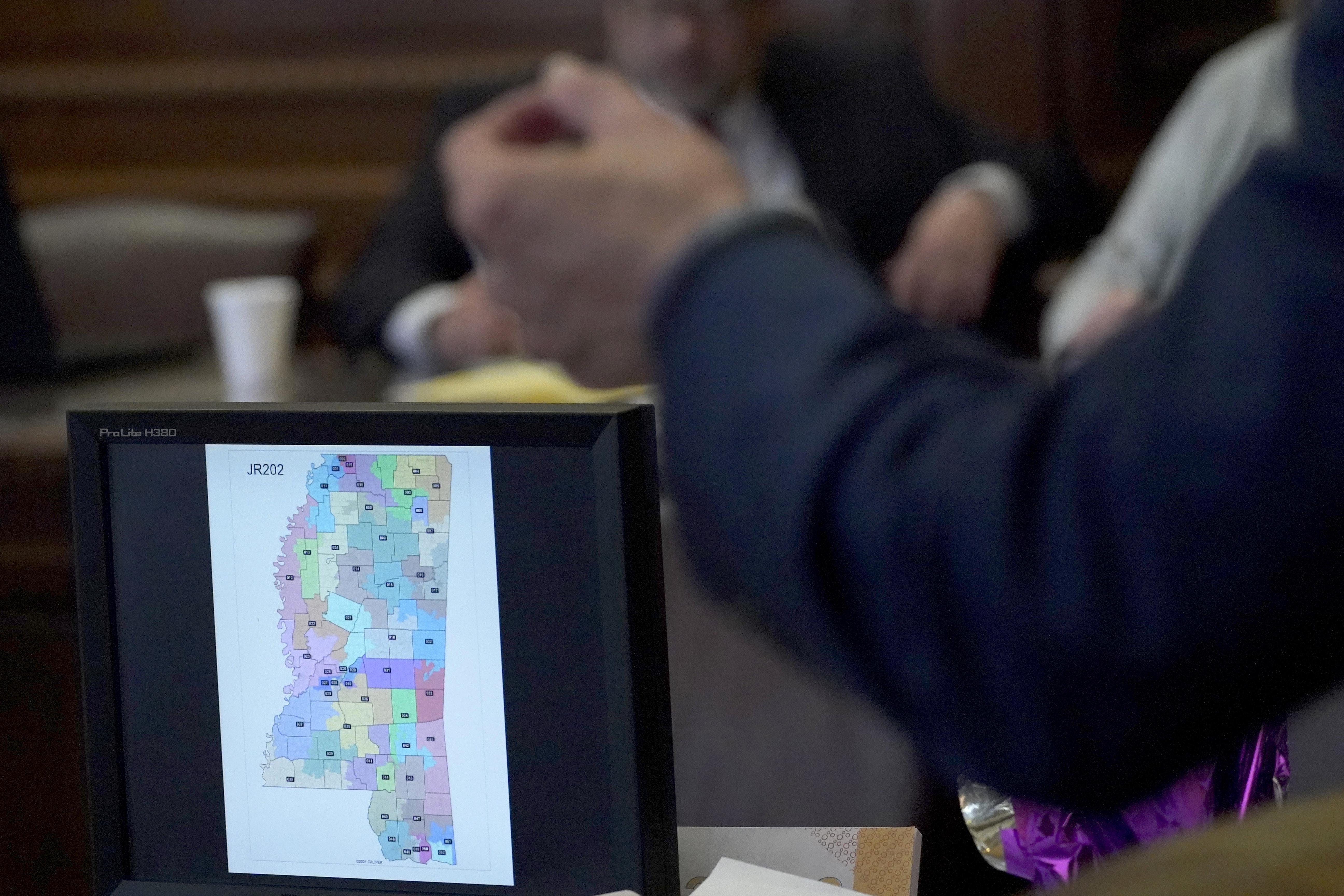
The brief order sends Mississippi’s legislative redistricting case back to the same federal three-judge panel that found parts of the state’s map diluted Black voting strength. The Supreme Court told the lower court to reconsider the case in light of its recent decision in Louisiana v. Callais, a redistricting case that narrowed how race can be used in drawing districts.
The order does not automatically reinstate Mississippi’s 2022 legislative map. But it does, in effect, restart the case under a vastly different legal standard.
“The district court has to sort this out and it has a number of options, everything from taking new evidence to dismissing the case,” Matt Steffey, a professor at Mississippi College School of Law, said.
The Mississippi case was brought by the state NAACP and several Black voters who challenged the state’s legislative maps under Section 2 of the Voting Rights Act. A federal panel previously found Voting Rights Act violations involving two Senate districts and one House district. Lawmakers drew new maps to comply with the ruling, and the state held special elections last year.
Those elections flipped two Senate seats and one House seat to Democrats, ending the Republican supermajority in the Senate.
Rep. Justin Crosby, a Democrat from Aberdeen, won one of those races. His House District 22 includes parts of Chickasaw, Clay and Monroe counties.
Crosby said the new district brought voters into the process who had not felt connected to state politics before.
“Many of the people that I went out and knocked on their doors had never had anyone come knock on their door,” Crosby said. “I’ve seen people say, ‘Oh, voting doesn’t change anything.’ Well, we proved that to be not true. I am living, breathing proof.”
Crosby said he worries the Supreme Court’s order could make those voters feel their political voice is being taken away just as they were beginning to use it.
Gov. Tate Reeves praised the Supreme Court’s order and said he believes it will ultimately lead to Mississippi’s 2022 legislative maps being reinstated.
“This opinion and decision is another win for the principle that all Americans are created equal,” Reeves wrote in a social media post.
The court’s majority did not explain its reasoning beyond sending the case back for another look after Callais.
Justice Ketanji Brown Jackson dissented, finding no basis for vacating the lower court’s ruling. She wrote that the Mississippi case presented “only the question of Section 2’s private enforceability,” while Callais did not address that issue.
The state’s appeal asked the court to rule that private plaintiffs do not have the right to sue over alleged violations of the Voting Rights Act. That, and other similar moves in other states, have drawn close attention from voting rights attorneys because private lawsuits have long been one of the main tools used to challenge electoral maps.
Instead, Steffey said, the court sidestepped the issue by sending the case back under Callais.
“So it’s back to where we started from, except the rules of the game have changed,” Steffey said.
The order comes as Mississippi’s legislative leaders are already laying the groundwork for a round of legislative, judicial and congressional redistricting.
Lt. Gov. Delbert Hosemann has created a Senate Select Committee on Redistricting and Reapportionment to study potential changes to all the state’s districts after Callais. House Speaker Jason White also named a House Select Committee on Redistricting as part of a broader group of committees preparing recommendations ahead of the 2027 session.
Byron D’Andra Orey, a political science professor at Jackson State University, said the legal shift from Callais is especially consequential in Mississippi because the state’s politics cannot be understood as race-neutral.
Orey said Republican officials may frame upcoming redistricting fights as partisan battles. But in Mississippi, he said, race and party are so closely linked that changing district lines for partisan advantage can also change whether Black voters have a realistic chance to elect their preferred candidates.
“That’s going to be an uphill battle to suggest that this is not about race in Mississippi,” Orey said.