Earlier the day, that number got up to 175,000 outages, according to poweroutage.com.
At a press conference on Sunday afternoon, Governor Tate Reeves said emergency managers and first responders are trying to work quickly under precarious conditions to restore power, with 47 counties affected by the storm and 37 covered in ice.
"I don't even want to try to begin to forecast or estimate when some of the power can or can't be put back on," Reeves said. "In some of the northernmost counties, the roads are such that they haven't been really been able to get out and get a real assessment."
"At this time, trying to put a timeframe on it would be pure speculation on my part."
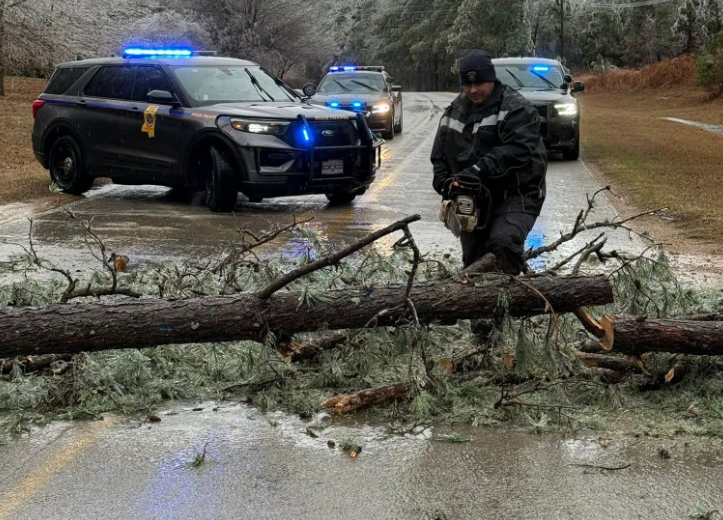
While they've been able to send out workers to restore power to some parts of the state that were severely affected along with crews to clear the roads, there's difficulty getting out quickly.
"Our people: emergency managers, first responders are itching to get to you," said Reeves. "Ice is different and that's what's challenging about this event, and the size and the severity of it, is because we can't naturally get people out and about as quickly as we'd like just because of the safety of the roads."
But, he said Reeves added that on Saturday, President Donald Trump approved emergency declarations for federal assistance in several southern states, including Mississippi.
"That obviously frees up resources for us to move around the state," Reeves said. "We've requested from our partners at the Federal Emergency Management Agency 30 generators, several truckloads of water, several truckloads full of MRE's (Meal, Ready to Eat) and we've also been in conversation with them regarding cots, blankets, tarps and other essentials."
Other than those federal resources, Reeves said they did not currently have plans to deploy the Mississippi National Guard to assist with emergency response. Reeves and other officials said they were working to get those resources to local agencies as quickly as possible.
Currently, the Mississippi Emergency Management Agency is maintaining an updated list of warming centers by county for folks who are unable to stay warm at home or who don't have shelter. Their website also has a list of county emergency management contacts and their information.
"We have approximately 58 warming shelters open all throughout the state of Mississippi," Reeves said.
Lafayette County was the heaviest hit with about 20,000 outages, followed by almost 14,000 in Alcorn County and about 13,000 in Lee County by early Sunday afternoon. In many counties up north, over half of homes and businesses had lost power.
Nearing the late afternoon on Sunday, power outages had begun to decrease, like in Lee County. Their emergency management director Lee Bowdry said that while they were dealing with some outages, the majority of their roads were clear.
"We had plenty of time to make sure that we had everything in place with generators and other supplies that we made sure that got from MEMA early in the week," Bowdry said. "Pre-planning is the best thing in any disaster and I think we did well with that."
Much of Lafayette, along with several other heavily impacted northern counties, is served by North East Mississippi Electric Power Association. In a Facebook update early Sunday, CEO and general manager Keith Hayward called current conditions "dangerous" and predicted a "long duration restoration" ahead.
"We are not in a real big storm restoration mode yet," he said. "We are still in an emergency mode where we're trying to get lines out of the roadways, trying to help people get out from their houses, trying to help the other first responders with medical conditions and firefighters and such."
Hayward added that they'd be getting help from other crews in Mississippi, as well as from Alabama and Georgia.
Entergy additionally reported heavy outages across central and north Mississippi, into northern Louisiana. In Grenada County, nearly 10,000 people were without power by Sunday afternoon.
Grenada's county director of emergency managment, Chris Whitehurst, said they were working with state emergency management to restore power, but the icy conditions were pushing back efforts.
"They have crews out, but they can't give us any idea of when power will be cut on, because as soon as they fix one line, a tree falls on another," Whitehurst said.
By late Sunday morning, the National Weather Service in Jackson forecasted that precipitation was slowing down, meaning the chance of additional ice accumulation would decrease.
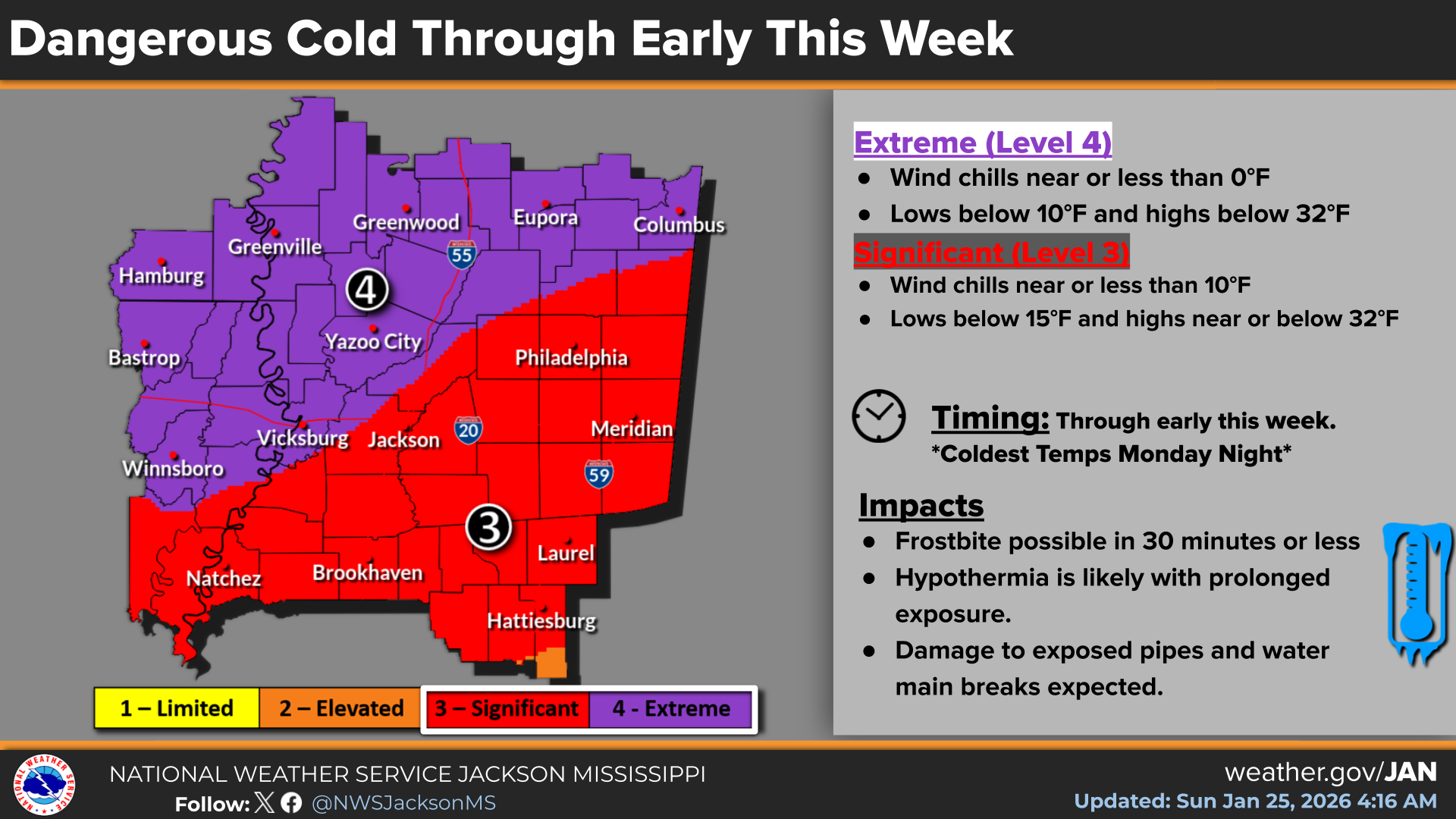
Cold air coming in, however, was predicted to cause downed trees and falling limbs in areas that already had ice buildup.