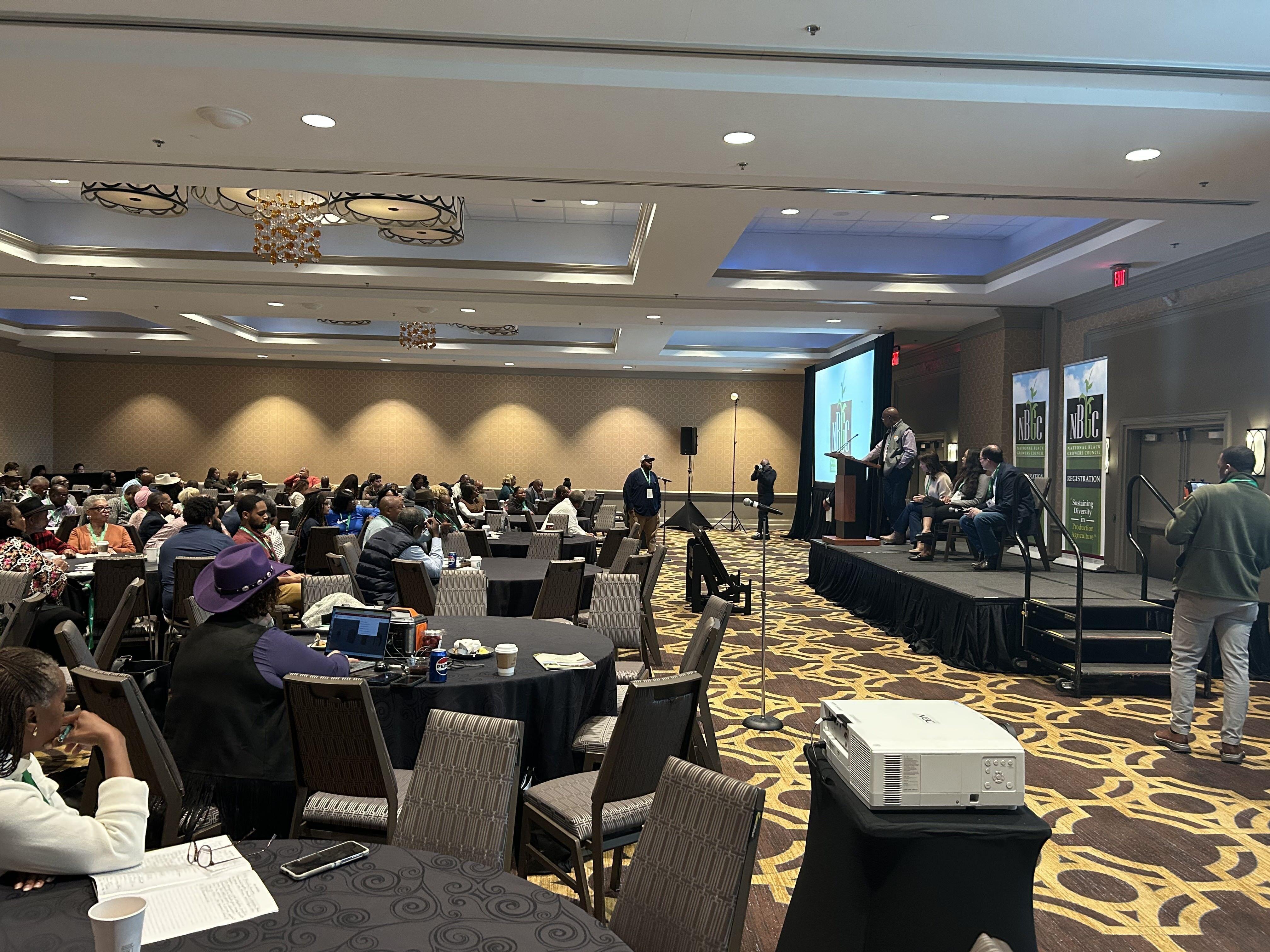
Black farmers like Haynie and Davis make up less than 2% of all U.S. farmers — and Black row-crop farmers, like those at this week's conference, are an even smaller slice of that.
"Our herd is small," Haynie said, "and if we can protect the herd, the herd will grow."
Black farmers have asked the federal government for loan relief and other assistance for decades. A century ago, Black farmers owned at least 16 million acres of land. Today, Haynie said they hold around 2 million.
Following the Civil War, Black Americans were promised "40 acres and a mule" by the federal government, but many say that promise never came to pass.
Over the course of the past 100 years, the amount of Black-owned farmland dropped by 90%, according to Data for Progress, due to higher rates of loan and credit denials, lack of legal and industry support and "outright acts of violence and intimidation."
Advocates say the inability for Black farmers to get a start, and later the sharp drop in farming population, is in part due to what they call USDA's discriminatory lending practices, and often specific loan officers' biases. The agency is the subject of an ongoing discrimination class action lawsuit by Black farmers and additional litigation due to those and other allegations.
Much of that history plays into how Black farmers approach the Trump administration.
"The Black row crop farm community needs the support of the administration," Haynie said. "I can't … buy an $800,000 combine to sell $4 corn. The math doesn't math on that."
All farmers — "Black or white" — are responding to the same depressed prices, he said. But Black farmers, he argues, already a small percentage of total U.S. growers, and often operating at a smaller scale, have less buffer to absorb sudden market shocks.
As farmers look at their projected costs next year, economists say they're also navigating deep uncertainty in global markets.
"I think that a lot of farmers are still very much looking at the next year with some trepidation, thinking that their margins will continue to be very, very tight," said Joseph Glauber, a senior research fellow at the International Food Policy Research Institute in Washington D.C.
U.S. trade with China — historically the top buyer of American soybeans and other row crops — has not rebounded to pre–trade war levels despite a new agreement. Meanwhile, Glauber said, countries like Brazil have expanded production dramatically, seizing market share during the trade war and becoming the world's top soybean exporter — a long-term structural shift that U.S. growers now have to compete against.