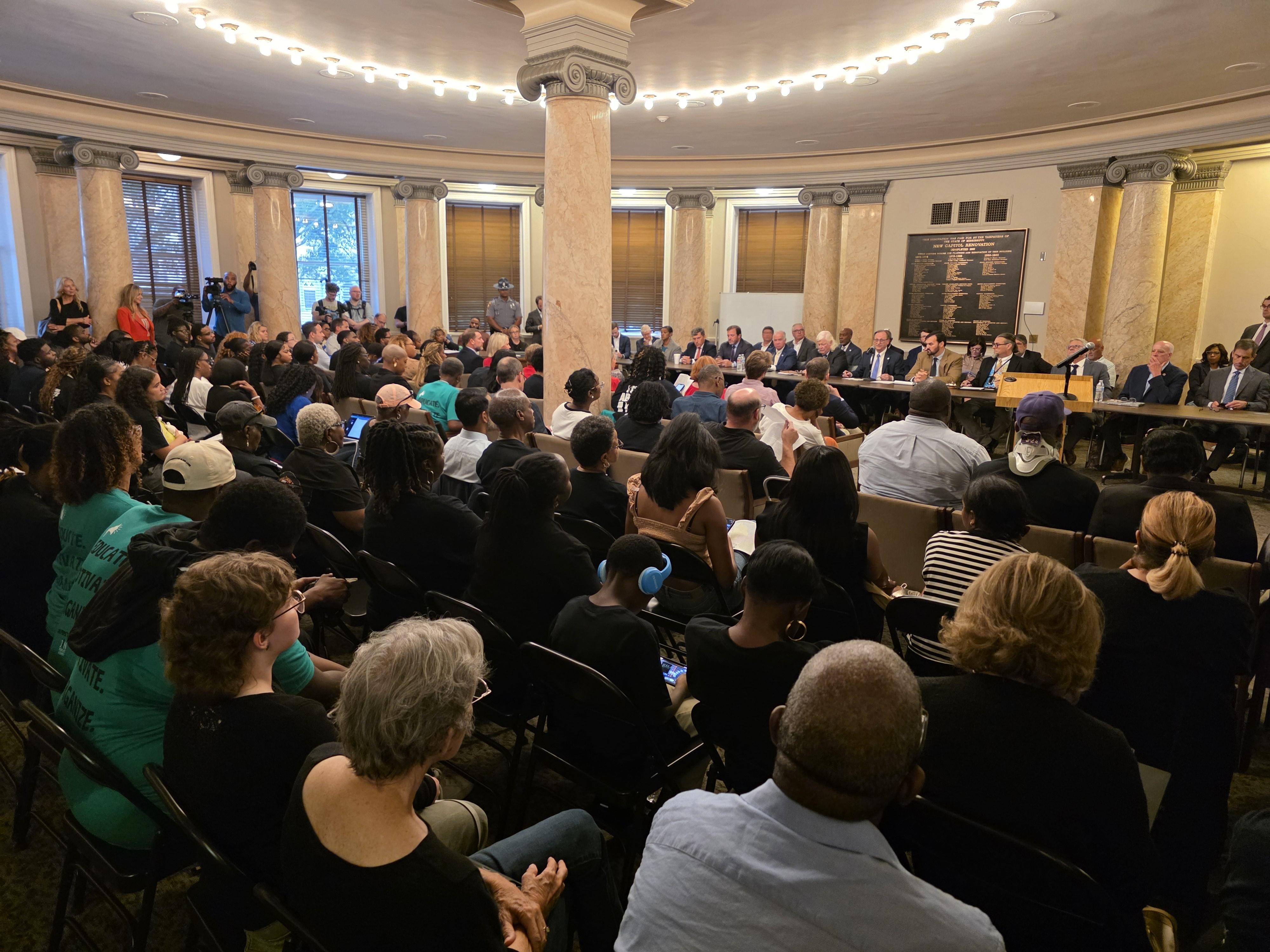
Meetings were held in Tupelo, Senatobia, Cleveland, Natchez, Meridian, Hattiesburg, Gulfport, and Jackson. During the final hearing on Oct. 1 at the Capitol, more than 60 people addressed lawmakers. Some supported redistricting, but the majority said any attempt to change voting maps would hurt Black voters.
During the hearings, lawmakers explained briefly why they were gathering public comments, but they declined to answer any questions about the redistricting process.
The first speaker in Jackson was Republican State Auditor Shad White, who said redistricting would provide an opportunity to remove Democratic 2nd District Congressman Bennie Thompson from office.
White said, “I just wanted to encourage you to, at some point in the near future, take up congressional redistricting. And I will just tell you this. The Delta has been at the bottom of far too many rankings for far too long and the Delta deserves better leadership than Bennie Thompson. It just does.”
Prior to the meeting, hundreds of people gathered outside of the Capitol to rally against redistricting. Among them was Democratic Representative Kabir Karriem of Columbus, who also heads the Legislative Black Caucus. He said he opposes any redistricting.
“It makes me very upset that we’re even having this discussion in 2026. It’s about race, it’s about taking, diluting representation of Black people in this state. And it should be very disturbing to every Mississippian that we’re even going through this,” said Karriem.
In addition to testimony delivered at each public meeting, lawmakers have received written statements and the hundreds of people who spoke at the public meetings, more have submitted documents online for lawmakers to consider if or when they draw new district lines.
Rep. Noah Sanford, a republican from Collins, said he is paying close attention to concerns from residents in the Pine Belt, where two legislators recently retired due to health reasons.
“We’ve had some people say ‘well, our county has been split’ or ‘our city has been split, we want it put back together.’ Those things are very helpful,” said Sanford. “There are a lot of small counties that are divided in the Pine Belt that I’d like to see put back together, so I think that the Pine Belt will be one of the regions that sees some changes.”
Mississippi law prohibits redistricting during an active election cycle, meaning lawmakers will have a small window to address redistricting if they decide to. That starts around late December and lasts through January. Governor Tate Reeves has not announced plans to call a special session of the legislature to address redistricting.