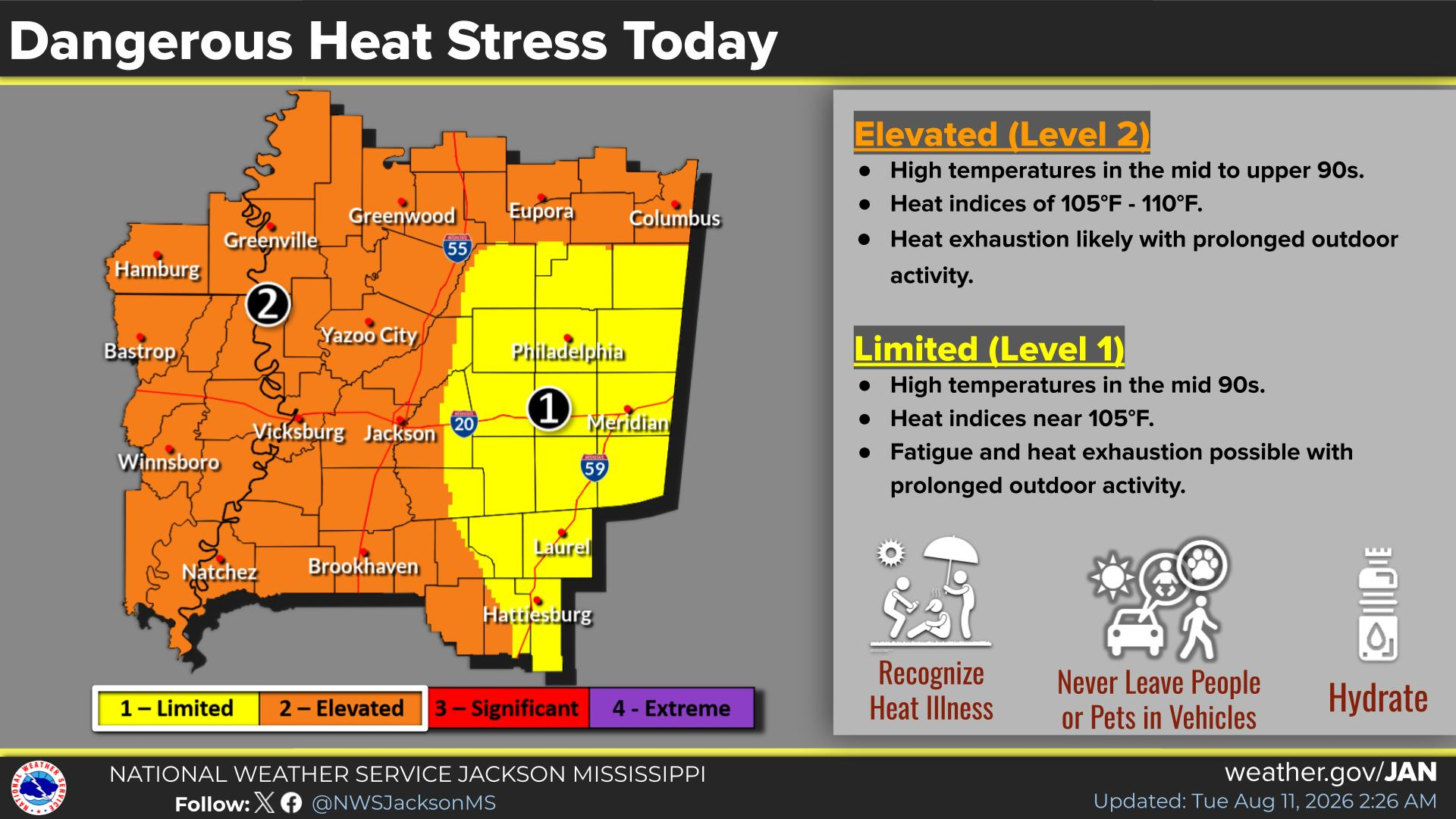
Heat indices could be well up to 110 degrees this week in certain parts of the state. Meteorologist Orion Alexander Jones with NWS Jackson says that while the whole state is going to be hot, residents in certain parts of Mississippi need to stay extra aware.
"The hottest temperatures as far as heat indexes is going to be the lower elevation areas, especially the Mississippi Delta region," Alexander Jones said.
Elderly people (those 65 and up) are most prone to health issues from the heat. About 22% of Mississippians are 60 and over.
"There are chronic conditions that may be more prominent in older adults," said Dr. David Buys, chair of the Department of Population Health Science at the University of Mississippi Medical Center. "There's certain medications that they may be taking that could affect how their body's able to regulate heat."
Paulita Edwards-Childs, Healthy Aging Bureau Director for the state department of health, says that means it's important to pay attention to symptoms like dizziness, headaches and nausea.
"You can't really distinguish them: is it my medication or is it because of the heat?" Edwards-Childs said. "In doubt, go to the hospital, go to nearest clinic, urgent care."
About 28% of Mississippians 60 and up live independently, according to the Mississippi State Department of Health. Edwards-Childs says that those residents need to stay especially proactive — you can be dehydrated even without feeling thirsty, so drinking water throughout the day is critical.
One of the best steps is to have friends or family checking in routinely to make sure that everything is running smoothly at home.
"Check on them at least twice a day: ask pointed questions about how they're doing and what they're are doing," said Buys, with UMMC. "Are they getting enough water? Is their air conditioning running appropriately? Are they staying cool?"
Life alert necklaces are another good safeguard, said Edwards-Childs.
"[If] you don't have a cell phone near you, you definitely can press that button on that life alert and someone will come to the rescue," she said.
When checking in (or, in keeping the home safe if you're living independently), there are ways to make sure a home is set up to minimize the heat.
"You want to keep your blinds down, so they won't bring in all that heat," said Edwards-Childs. "We want to make sure that the air is circulating in the home through fans and ceiling fans."
And, even if you can't do that yourself, Buys recommends looking at ways to remotely make sure a house is staying cool.
"Install controls in your loved ones' homes so that you may be able to remotely monitor," Buys said. That monitoring could be something like a remote thermostat, so that you can control the home's inside temperature, no matter where you are.
And, he adds, there are other places to stay cool, especially for older residents who want to keep electric bills down.
"People in larger areas may want to go to a mall," Buys said. "We have area agencies on aging all across the state that are associated with our planning and development districts that may have locations where older adults could go for particularly the hottest parts of the day."