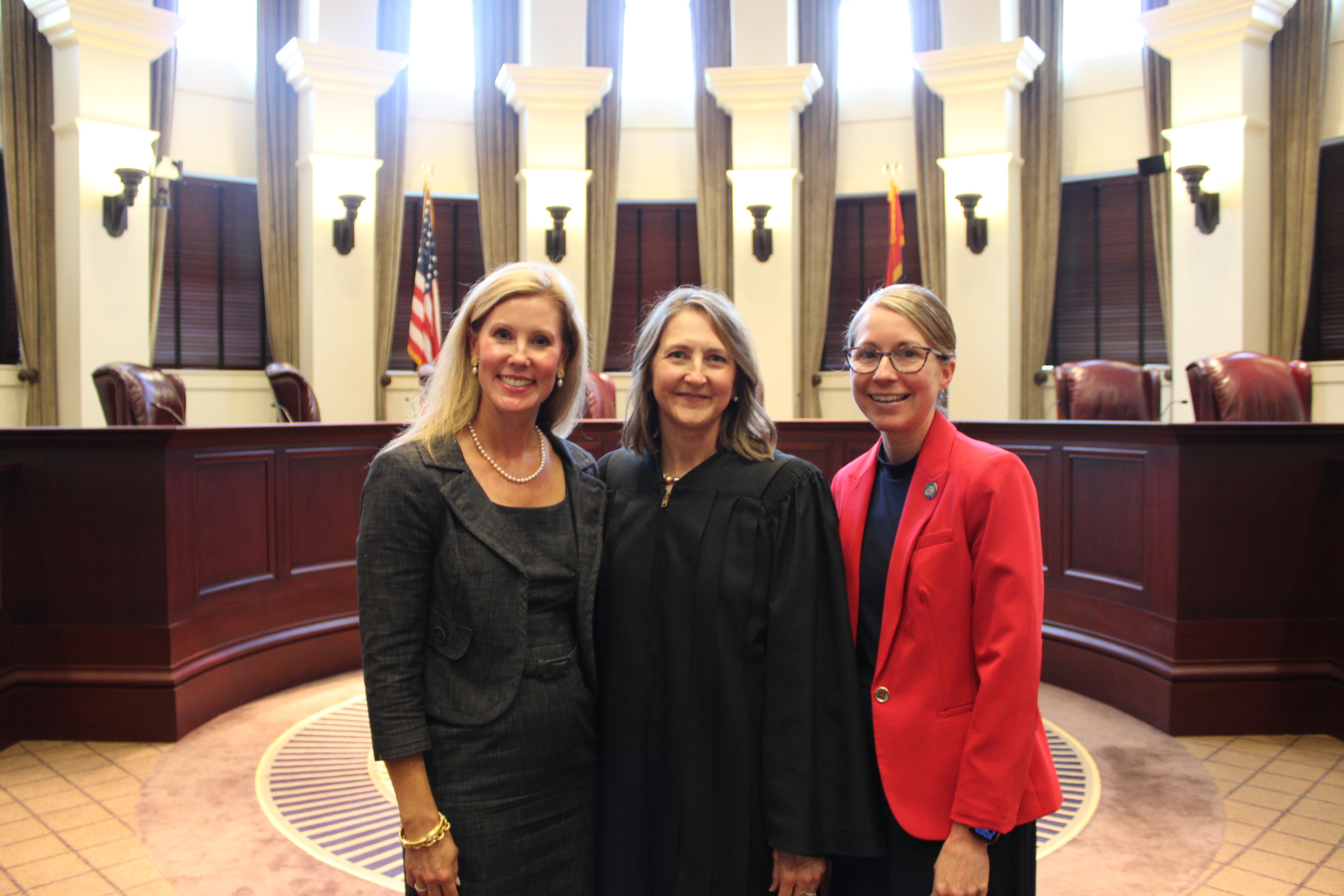
Tollison, an Amite County native who has practiced law for about 30 years, said the court's current makeup mirrors the state's legal profession and general population.
With a background in litigation, regulatory, and administrative law, Tollison said her experience advocating for clients offers a distinct perspective as she transitions to deciding cases.
She also stressed the weight of serving on the state's tribunal of last resort.
“This office is an office of public trust,” said Tollison.
Tollison noted that attorneys and judges are expected to maintain high ethical standards and treat others with respect, adding that she aims to bring honor to the court.
For women entering the field, she said her career trajectory demonstrates that professional paths are not always predetermined.
Tollison said she never envisioned serving as a Supreme Court justice, but instead sought leadership and service opportunities within her community and profession.
“I got a lot of help along the way from people that I’ve practiced law with, people that mentored me and people that I worked with,” Tollison said.
Justice Wilson similarly noted that her career was not built around an expectation of reaching the high court. After starting in an assistant district attorney's office, she served as a county court judge and circuit court judge before joining the Supreme Court. She hopes women and girls observing the court realize that reaching leadership positions is achievable.
“You can do what you want to do if you put your mind to it,” said Wilson.
Justice Jennifer Branning, a former Mississippi state senator elected in 2024, became the first woman elected by popular vote to the Mississippi Supreme Court. She assumed office in January 2025.
Branning said the court's composition reflects extensive professional dedication rather than gender alone.
“It was not our gender that got us here, but rather our decades of hard work and display of excellence in the legal profession, ” said Branning.
Branning described her passion for the law as centered on helping individuals resolve complex problems.
“I don't know how to explain my love for the law. I'm just mesmerized by the study of law and formerly the practice of law,” Branning said.
The change is also being noticed inside Mississippi law schools.
John Anderson, dean of Mississippi College School of Law, said women have outnumbered men nationally among law school applicants and enrolled students since around 2016, a trend now expanding representation across the profession.
At MC Law, Anderson said administrators focus on cultivating a welcoming environment for a diverse student body, noting that visible achievements by graduates encourage current students to pursue high-level careers.
“Anything is possible, achievable in Mississippi now ... there's a new story to be told for Mississippi,” said Anderson.
Camille Waller, a third-year law student and Student Bar Association president, recalled starting law school when only one woman sat on the state Supreme Court.
“Now I'm about to graduate and there's three ... that's so inspiring. It's every little girl ... you wanna look up to someone and say, oh, I want that to be me. And now we know that can be us,” said Waller.
Waller plans to practice family law in Mississippi after graduation, citing hands-on opportunities at MC Law working with children and families.
Clinecia White, a second-year law student and president of the Black Law Students Association, said seeing three women serve together on the bench reinforces her goal of becoming a judge.
“This topic is so important to me because I do want to be a judge one day. I do aspire to be on the bench one day, so seeing three women serving concurrently on a bench is very inspiring to me,” said White.
White returned to Mississippi after graduating from Tuskegee University to give back to her community, noting that MC Law's supportive environment has helped guide her studies.
Legal educators and the justices emphasize that the broader impact of this milestone reaches far beyond the courtroom environment.
Justice Wilson said representation helps demonstrate to young women that public service careers are attainable, while reminding the public that members of the judiciary bring diverse personal and professional backgrounds to the bench.
“I think it's a wonderful opportunity for other women to look around and decide where they want to contribute,” said Wilson.
For Wilson, serving on the bench is primarily an act of public duty rather than a historic milestone.
“I don't see myself as a statistic, I see myself as a public servant,” said Wilson.
The justices view the moment as an opportunity to serve Mississippi while creating pathways for future generations of legal professionals.
Tollison and Wilson are scheduled to face voters in Mississippi’s special election on Nov. 2, 2027.