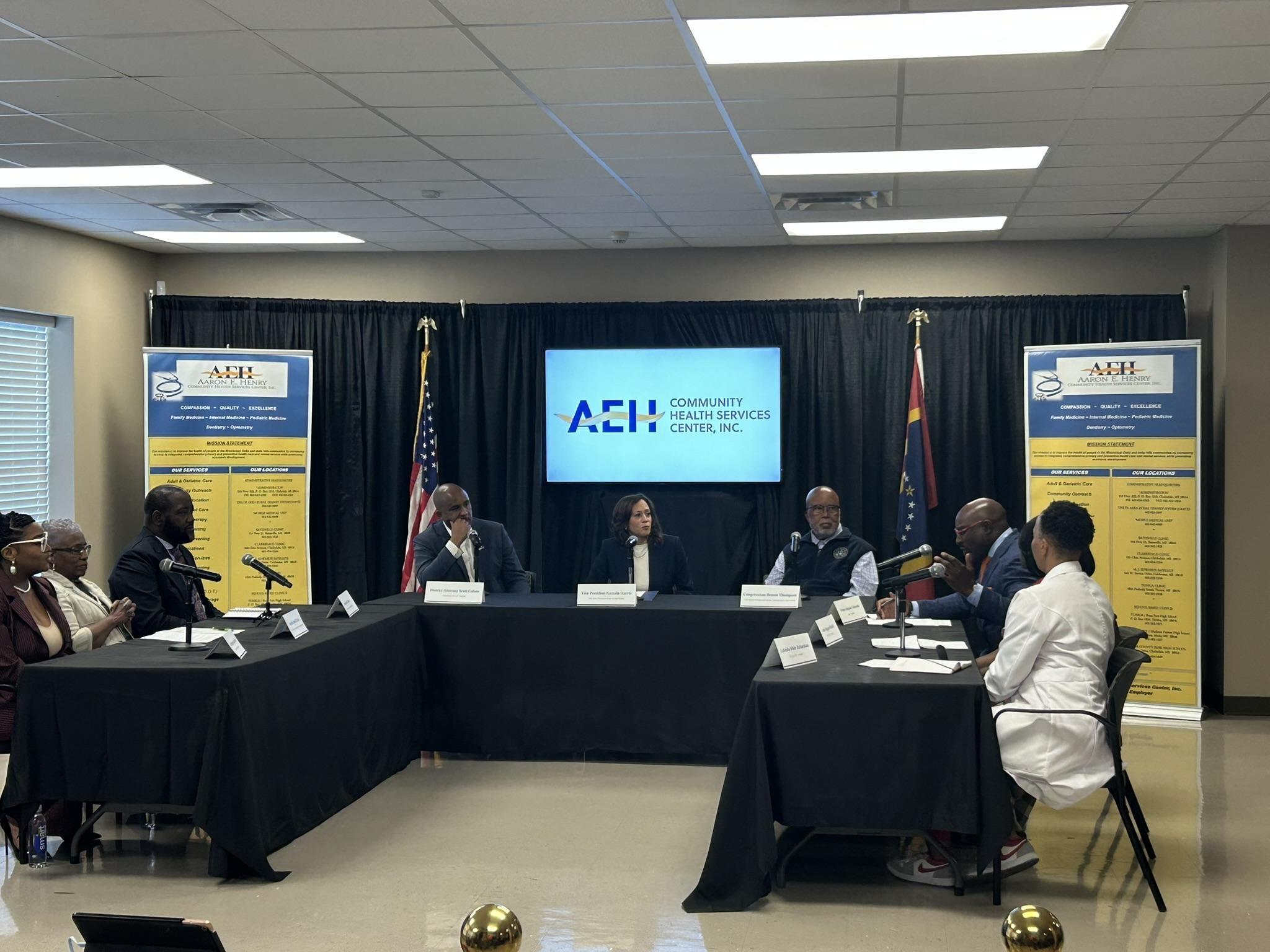
The former Vice President touched down in Clarksdale on Thursday to discuss healthcare and rural hospitals with local healthcare professionals and politicians as part of campaigning with district attorney Scott Colom.
“It doesn’t have to be this way,” Harris said. “A young mother who prays to have healthy babies deserves to be able to have that experience and that joy.”
“A family who needs emergency care should not have to worry about the fact they can't afford the gas to drive the number of miles away from their home to have critical care.”
Healthcare and saving rural hospitals have been major pillars of Colom’s platform. At least half a dozen rural hospitals are at risk of closing in the state and over 700,000 Mississippians are on Medicaid.
The One Big Beautiful Bill Act made changes to Medicaid funding last year that could have heavy impacts on rural hospitals.
“If we do not restore the support for people on the Affordable Care Act so they can actually afford insurance, if don't get some form of a public option in the long term so people can have competition in the market where they can afford health insurance, not only are we violating the values that we were all told to as children,” Colom said. “But we're betraying our people.
Dr. Lakeisha White Richardson, a Greenville OB-GYN, highlighted the particular issues facing women and children. A year ago, the state declared infant mortality to be a public health emergency.
“One in three counties are considered a maternity desert: that means women have to travel more than one hour to receive care,” Richardson said. “Then it becomes a race against time.”
“If a woman is having a placental abruption, if she's having preeclampsia, if she is having an eclamptic seizure, cardiomyopathy, postpartum hemorrhage, she needs to be in a hospital within 15 minutes – not one hour, not two hours, not three hours.”
KyAmbernecia Earvin, an Athletic Academic Counselor at Mississippi Valley State University, told panelists what that looked like for her when, two years ago, she gave birth to her son at 21 weeks.
“At that time, there wasn't a doctor at the hospital that was able to see me because there was a lack of doctors at that facility, so I laid there for about 16 hours before I was transported to Jackson,” said Earvin. “Not only did I not have a doctor that was able to see me, they had to wait for an ambulance.”
“I did not make it to Jackson until about 6:00 p.m. the next day. I gave birth at 10 o'clock, and he was unable to go to the NICU because they didn't have any equipment that would support him.”
Her son ended up passing away.
“We need hospitals with more equipment,” said Earvin. “We have passionate doctors here, but they need more support, they need other doctors there to be able to help them.”
“I think they're afraid to come to the area because we don't have the funding.”
Dr. Undra Haggan-Mitchell, a family nurse practitioner at Aaron Henry Community Center, pointed to the financial challenges facing the Delta, particularly with Medicaid.
“That needed payment source for family and children is top priority,” Haggan-Mitchell said. “80% of the population that I serve depend on those Medicaid services: the reapplication process has hindered the children and families from being able to actually have access to Medicaid, specifically because they have no knowledge of the actual strategic process that it takes to actually apply for Medicaid.”
Congressman Bennie Thompson also joined the discussion – Thompson has represented large swaths of the Delta for decades.
“The second district is 30 counties: all 30 counties are medically underserved,” Thompson said. “I have five of those counties that we don't even have a hospital in; four of the hospitals, including the one here in this county, have gone through several bankruptcies.”
He said that the fight for healthcare in the state hits a brick wall when it comes to support at the federal level. That's especially with Medicaid expansion, which Mississippi didn't opt into.
“We have lost $1.2 billion since the passage of the Affordable Care Act,” said Thompson. “So that means that most of the healthcare facilities go under because of bad debt or compensated care, which [could] be readily addressed.”
Sustainable funding, transportation and educational and vocational support for healthcare professionals were all resources that folks at the table with panelists said could move health forward in the Delta.
“The workforce shortage also warrants financial assistance so that the people in the community can also benefit from the resources that are provided,” said Haggan-Mitchell. “Then those actual people can actually work in the community that the resources are here for.”
“Otherwise, these people will have to travel for medical services and for jobs and we already know that that's a problem.”
Harris pitched Colom as Mississippi’s chance to have a Senator who understands all those issues and would do something about it.
“When we understand that we are in the season to then have that on one hand as a choice for the next United States senator from Mississippi,” said Harris, “And on the other hand, someone who voted for a $1 trillion cut to Medicaid – we can turn pain into purpose.”