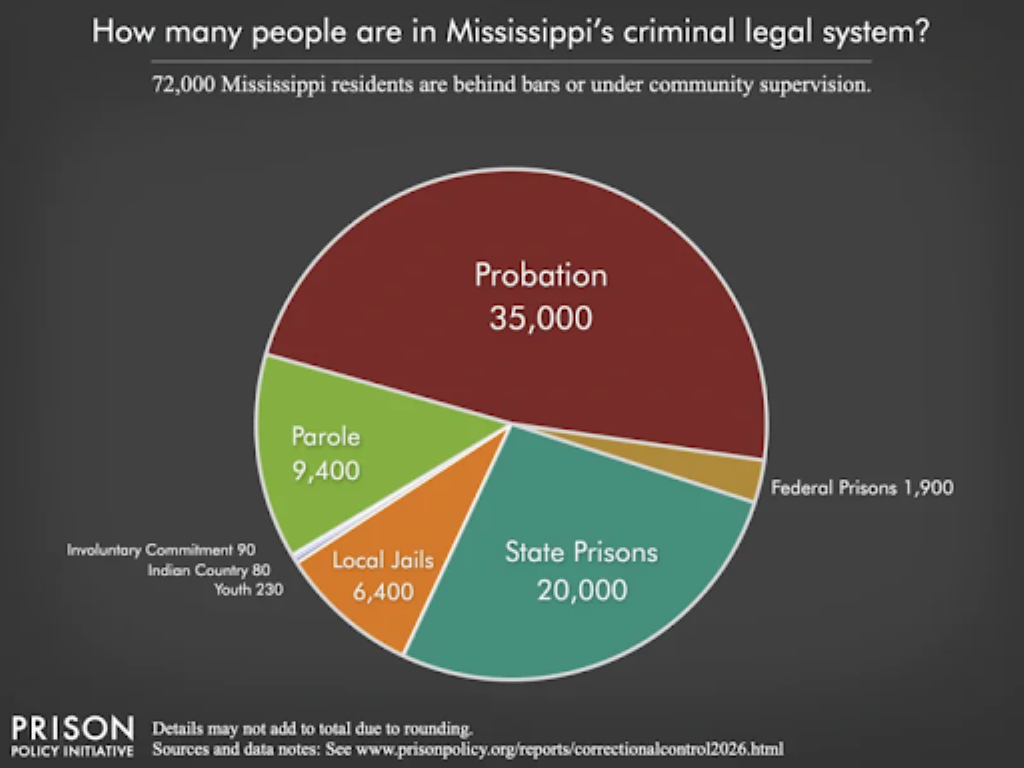
While de Gruy pointed to very specific facets driving Mississippi’s rates, MDOC commissioner Burl Cain sees the problem on the grand scale.
“We don't want to set people up to fail, and we have,” said Cain. “Not only here, but everywhere, so this is a thing that we're looking at across America.”
Cain stressed the work of MDOC in rehabilitation and of Mississippi’s prisons not just being places to “lock and feed, torture and torment,” though the agency has been under fire in recent years for persistent and severe healthcare issues in its prisons.
His focus was on the time people spend in prison, citing rehabilitation and practical job skills preparation as critical elements to driving parole and probation rates down, and especially rates of reincarceration. MDOC has some programming for post-secondary and vocational education.
“If I don't have you prepared for the workforce, you're gonna wander around without a job, then you're going to smoke dope,” said Cain. “Then you're gonna deal dope and drugs because that's the only living you can make: selling drugs, then you're going to get caught.
“Then the ones you're dealing to are going to get caught, too. You're gonna just keep on growing the prison population, and it's not gonna work.”
But Cain also expressed mixed feelings on programs cutting time down on parole and probation.
“I think if they're performing well on parole and they're following the rules and they are paying their fees and they are doing everything that's supposed to be and they are employed, I think yes,” Cain said in regard to reducing sentences. “But if they are out there missing, not doing that, not complying with the parole and so forth, stay a little longer.”
He similarly shifted responsibility for technical violations to individuals, although he did partially attribute issues with technical violations to failures on the part of corrections.
“You keep letting them get away with it; they can get worse and worse,” said Cain. “It's better on the front end as soon as they do the violation at home, that you do something to them and have some kind of little punishment or some kind of little restrictions so that you can rein them in early.”
Cain said, like de Gruy, that support in navigating the conditions of community supervision and technical violations are helpful for individuals on probation and parole.
For Kang-Brown, that’s a critical element to meaningfully breaking the revolving door of incarceration and community supervision.
“It's important that states and counties work together to reduce the number of restrictions that people are under,” said Kang-Brown. “The sort of standard conditions of probation that people are on make it too easy to fail and then get sent back behind bars.”
This story was produced by the Gulf States Newsroom, a collaboration between Mississippi Public Broadcasting, WBHM in Alabama, WWNO and WRKF in Louisiana and NPR.