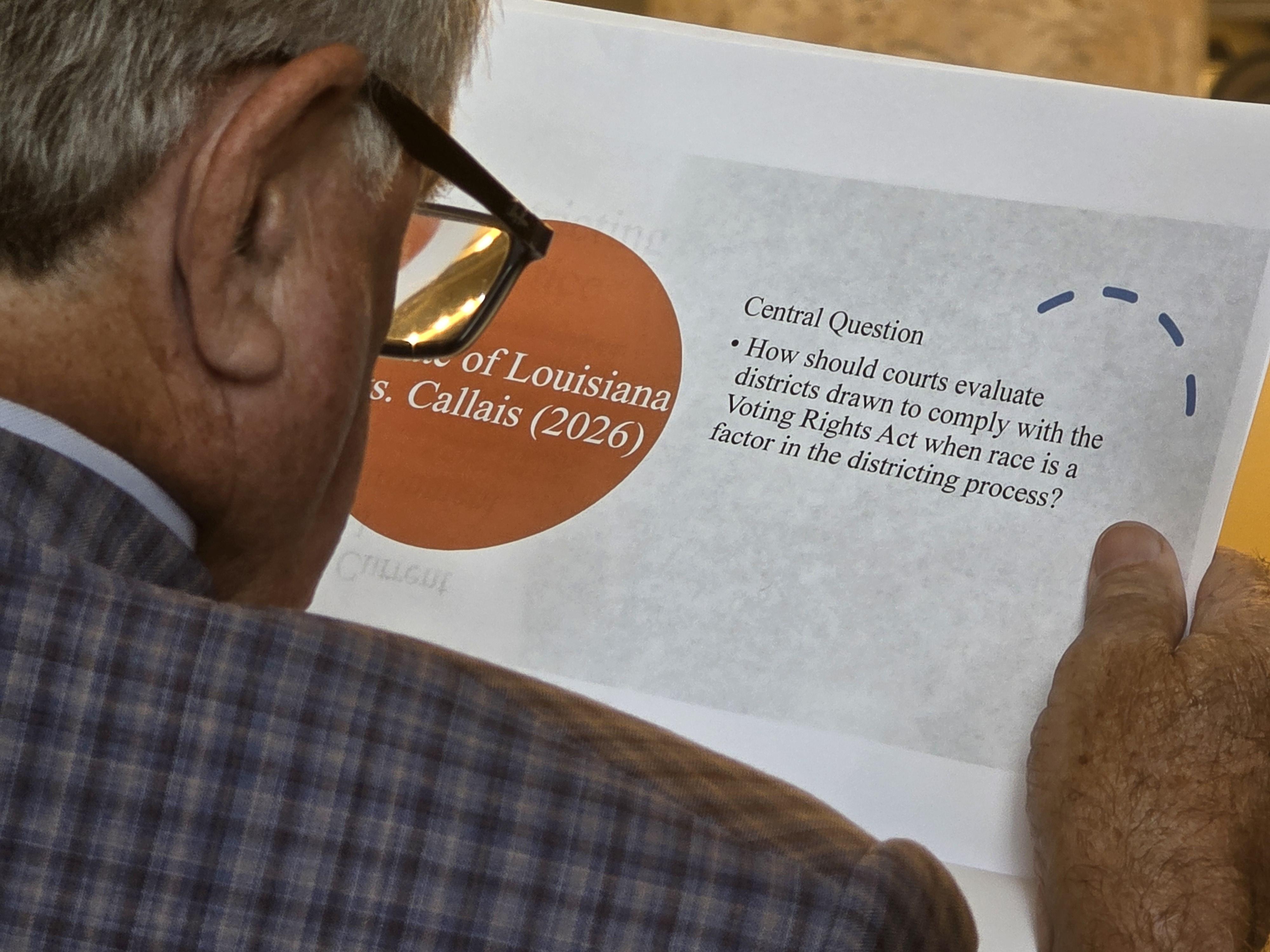
The ruling’s removal of race‑based requirements has set off a contentious debate at the Capitol over what principles should guide the next set of boundaries.
During a hearing Monday, members of the House Select Committee on Redistricting heard testimony from Dallas Breen, executive director of the John C. Stennis Institute of Government and Community Development. Breen said lawmakers must answer several key questions before deciding how to reshape districts.
“Where is the population changing? Are they moving in state? Where are they moving in state? Where are we seeing that shift,” said Breen. “Where is the most activity happening? How should committees of interest be considered, the legal risks, and can you improve transparency?”
Republican lawmakers say they want to approach redistricting without using race to draw lines. Democrats say that race in Mississippi is deeply tied to economic power, local cultural factors and political affiliation, making it inseparable from fair representation.
Democrats and several voting rights groups held a press conference on Monday criticizing what they described as Republican efforts to diminish minority influence in redistricting. Democratic members of the House did commit to participating in the redistricting process so minority communities are represented and heard.
Amir Badat, Southern States Director and Senior Advisor at Fair Fight Action, warned that the public input must be taken seriously, and accused lawmakers of treating hearings as a formality.
“This is not an effort to increase fairness in Mississippi’s redistricting maps. This is an effort to discriminate against Black Mississippians.”
Republican lawmakers reject claims that their approach will weaken Black voting power. Rep. Noah Sanford, chair of the House Committee on Redistricting, said his goal is to keep counties and cities intact to better represent communities.
“My intention is to try to keep counties together, try to keep cities together,” said Sanford. “There’s a small town in my district that, the way it was drawn, I represent half the town. Another member represents the other half of the town. That should not be. We need to get rid of that, and that’s my intention.”
As the process moves forward, lawmakers from both parties agree that public participation will be crucial. How the Callais ruling ultimately reshapes Mississippi’s political landscape and whether communities feel heard remains unresolved.