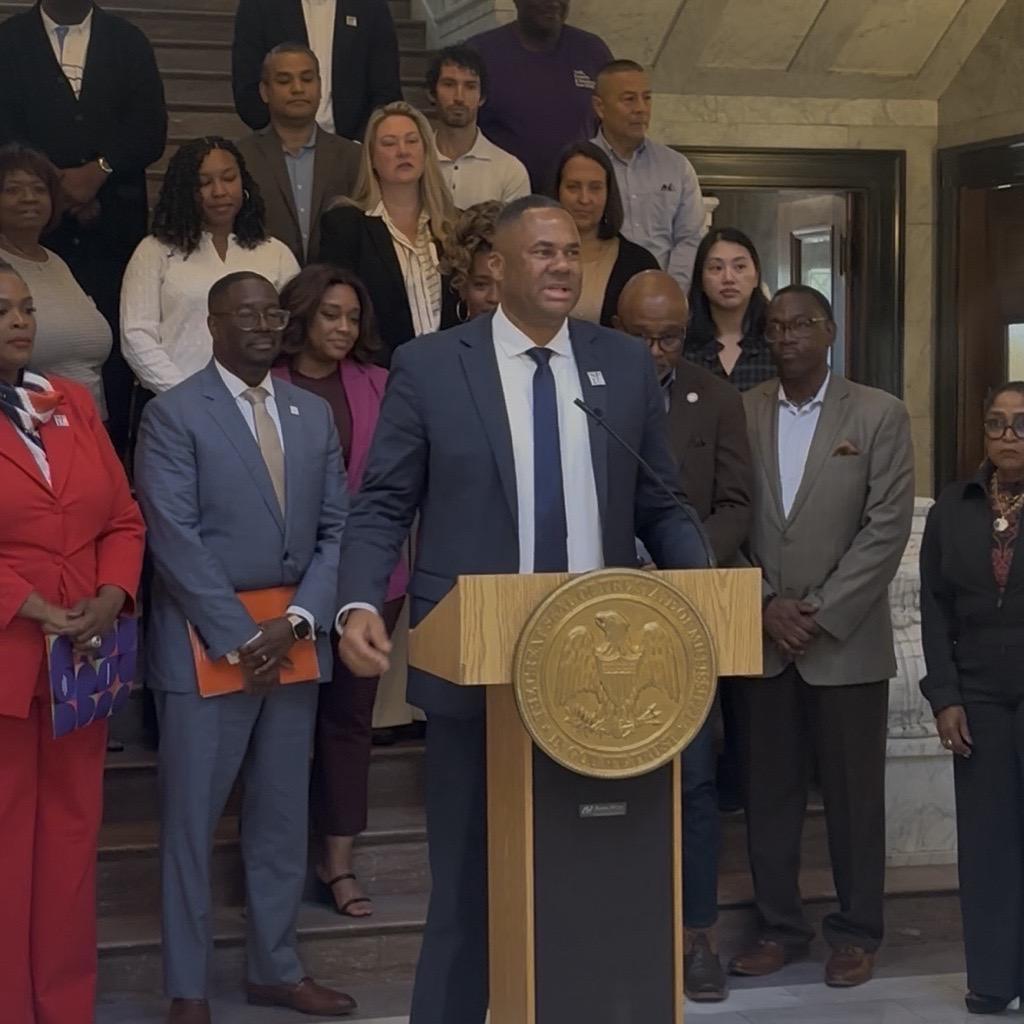
State Rep. Zakiya Summers urged voters to hold lawmakers accountable for blocking legislation designed to expand essential community resources.
“There are families out here that are working paycheck to paycheck, trying to figure out if they can afford Wendy's or if they could go to the grocery store and buy some other protein that we're supposed to be trying to buy, right?” Summers said. “So, our colleagues need to be addressing the real questions of the day and if they cannot answer that question in the affirmative then they've got work to do.”
Ryan Haygood, president and CEO of the SPLC, noted that 1 in 5 Mississippians lives in poverty—an issue that cuts across racial lines.
“Mississippi's problem is not a scarcity of resources, it's just the way that those resources are invested in low-income people or not. Part of the Truth, Poverty, and Democracy tour is imagining a Mississippi that will build in this difficult moment,” Haygood said. “That will be advantageous for low-income people across Mississippi, not just as a way to mitigate being poor, but to actually abolish poverty as a system.”
Advocates also addressed widespread food insecurity impacting families across the state.
Eric Mitchell, president of the Alliance to End Hunger, said more than 600,000 Mississippians lack reliable access to nutritious food.
“We often talk about food as medicine. One in seven Mississippi adults has diabetes, And the Delta has the highest cardiovascular disease death rate in the country,” Mitchell said. “We need to turn successful pilot programs like produce prescriptions into lasting programs backed by healthcare providers, insurance, and policymakers.”
Mitchell emphasized that the scarcity of farmers markets in rural and low-income areas severely limits fresh food access. He added that federal assistance programs like SNAP and TANF are vital safety nets, though recent federal legislative shifts under H.R. 1 have created new barriers for eligibility.
Theresa Lau, senior federal policy counsel for the SPLC, explained that administrative changes under H.R. 1 have burdened both families and state administrators with increased paperwork. She added that the law shifts financial responsibilities, requiring Mississippi to cover 70% of SNAP administrative costs and potentially facing nearly $80 million in cost shifts next year if error rates remain high.
“There's some time to take action and do something about this, to raise, tell a friend, tell your community, explain to them the harmful impacts of this bill so far,” Lau said. “And make sure that they talk to their members of Congress, talk to the state legislator, make sure the state also talks about this.”
“There's some time to take action and do something about this, to raise, tell a friend, tell your community, explain to them the harmful impacts of this bill so far. And make sure that they talk to their members of Congress, talk to the state legislator, make sure the state also talks about this.”
Lau warned that the legislation will continue to strain Mississippians as additional provisions take effect.
Bruce Case, a member of the SPLC Mississippi policy team, highlighted the growing economic pressure on struggling households.
“One in five Mississippians live below the poverty line. We're making it tougher and tougher for them to find their social safety net,” Case said.
Advocates closed by urging residents to thoroughly research candidates at all levels, stressing that local government decisions directly shape daily life.
Waikinya Clanton, Mississippi state director for the SPLC, said residents deserve proactive leadership and encouraged high voter turnout.
“Poverty in this State, unfortunately, is a policy choice… behind every statistic, is a person. Behind every policy is a consequence,” Clayton said. “The people of Mississippi deserve more than explanations on why things can't change. They deserve leadership with courage to change them. So remember this, we are not powerless. We have power to advocate. And yes, we have the the power to vote.”
The SPLC tour concludes its statewide run in Meridian.