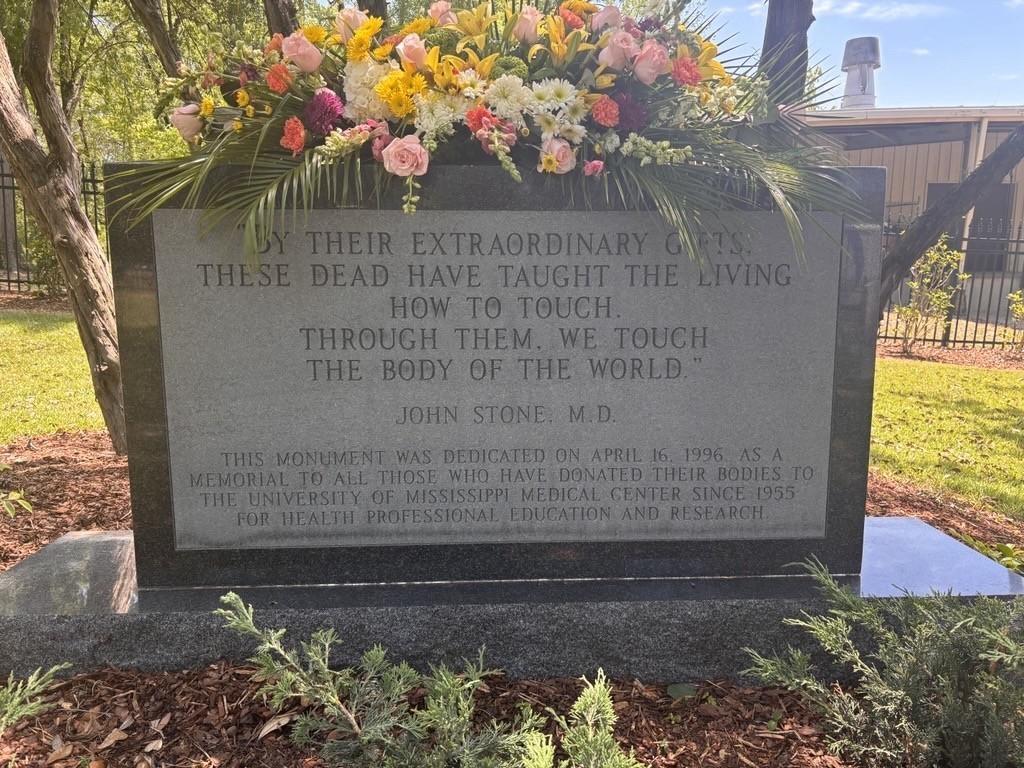
Mississippi established the Anatomical Gift Program in the early 1970s after adopting the Uniform Anatomical Gift Act. The program accepts only Mississippi residents and has about 15,000 registered living donors.
Dr. Nathan Tullos director for the Anatomical Gift Program emphasized the critical role donors play in preparing students for medical careers.
“So anatomical donation has always played a central role in the history of medical education, and the ability to learn anatomy is fundamental to the practice of medicine,” Tullos said. “So the sacrifice that the donors have made is critical to the education mission of the institution but also into raising and training clinicians whether they be dentists or doctors or nurses or other clinicians for the state. So it's central to the mission of The School of Medicine but also the institution as a whole.”
UMMC honors donors annually, recognizing 77 Mississippians this year who donated their bodies over the past 12 months.
First-year clinical anatomy student Jake Roberts said the experience provides both technical knowledge and emotional growth.
“Not only does it give you the knowledge of the body and the blueprint of how it's all laid out,” said Roberts. “It also gives you your first chance of compassion and empathy to really care for a patient and respect their body and who they are. It gives you a great opportunity to start working with others at your table. And I just think that it's such a foundational experience for all students. It's something that's very special that I know all of us appreciate very much.”
Students said they often begin with a simple question when working with donors: Who were they?
First-year medical student Anderson Rings said donors help shape future physicians.
“They taught us that every patient has a story, and that to care for them we must first take the time to know it,” said Rings. “Their legacy will remain with us in the years ahead, in operating rooms where steady hands matter most, in emergency departments where every second carries weight, and in rural communities of Mississippi where physicians are deeply needed, all because of what they first taught us.”
Jeffery Richardson said his mother, Caroline Richardson, entered the program in February 2025. She was a registered nurse for over 50 years and had always wanted to donate her body to a medical school. Once she moved from Louisiana to Mississippi, she was registered as an anatomical donor on her license. Richardson said it was an emotional and moving moment to see the students' appreciation for the program.
“Ever since I was small, that was her wish. I've never known anything different, she was very adamant that she wanted to donate her body to a medical school,” said Richardson. “She had to where she lived in Louisiana. Then when she moved to Meridian she put it on the driver's license. I’ve never known anything different about her wishes. This is what she's always wanted to do.”
Tracey Short's father, Robert Walters, entered the program in January 2025. Throughout the ceremony, Short said she felt the respect and gratitude the faculty and students had for the loved ones of those who donated. Walters, who had a lung condition, wanted to help others avoid the same struggles.
“I'm feeling very touched. A bit of sadness, a bit of joy at the same time, because this is closure,” said Short. “He has completed his journey. And we're just so grateful for the respect that everybody has shown.”
Short’s mother, Ann Walters is also a part of the program. She said both her and husband decided it was a worthy program to join.
“We filled out the forms and in return got a card that gave us all the information that we needed,” said Walters. “And we decided that this was the way to go. This was what we would do.”
University leaders said the impact of donors extends far beyond the classroom.
Dr. LouAnn Woodward, vice chancellor for health affairs, said students carry the lessons from their first donor throughout their careers.
“We appreciate the donors and their families so often, you know, when somebody passes away, that's a very challenging and hard time for a family,” Woodward said. “But for them to be willing to honor their loved ones' wishes and to exhibit this generosity and the kindness is really something that we cannot adequately have words to express our gratitude.”
After the program ends, families can receive their loved ones’ remains or choose burial at the university cemetery.