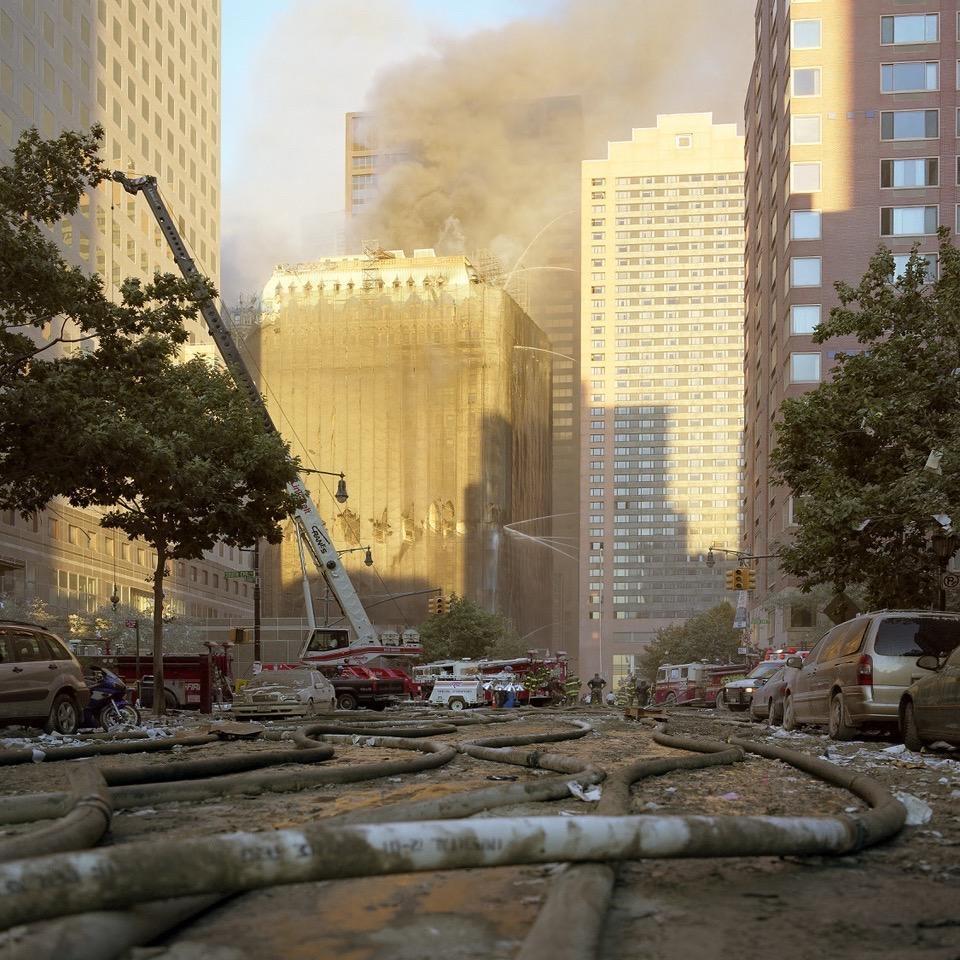
Barnes and Nicholas then headed toward Lower Manhattan to document what they saw as first responders worked to bring order to the chaos.
Nicholas said one photograph, featuring the Charging Bull sculpture near Wall Street, captures the atmosphere of that day.
“That photo with the police car in the background and all the other support vehicles there,” Nicholas said. “The paper on the ground, all the particulates in the air. That photo just really say ‘Okay, you’re in New York and this is really happening right now.’ That first one really just establishes the sense of place so well.”
For Barnes, the exhibit marks the first time his photographs have been publicly displayed in 25 years.
“I’m very honored and very thankful that 25 years later, these pictures have an outlet and are being seen,” Barnes said. “They haven’t been seen for the past 25 years.”
Nicholas said seeing the photographs displayed publicly has been deeply emotional.
“It’s emotional for me to see them after taking them 25 years ago. They really haven’t seen the light of day since then,” Nicholas said.
Indianola native Daniel Brassier was 21 at the time and a recent graduate of Mississippi College. He was starting his second day of a monthlong training program with Morgan Stanley.
Brassier recalled looking out the window that morning at a clear New York skyline before hearing an explosion and seeing paper flying through the air.
“I thought maybe it was a ticker tape parade or someone was dumping buckets of confetti off of the top tower,” Brassier said.
He soon realized the North Tower had been struck.
When alarms sounded in the South Tower, building attendants instructed occupants to enter the stairwell. While some believed it was a gas explosion or a helicopter crash, an announcement soon directed everyone not to evacuate.
Brassier said he trusted his gut and continued walking down the stairs. He was on a floor in the high 40s when the second plane struck.
He described the building swaying, the tower leaning, and the terrifying sound of creaking steel. He remembered people clinging to walls and doorways, and looking into offices where some colleagues were in wheelchairs.
He said the smell of jet fuel was so thick “you could taste it.”
After navigating what he described as an endless stream of people frantically trying to reach ground level, he eventually made it outside and escaped. He walked back to his hotel to reunite with friends.
In his recorded interview for the exhibit, Brassier reflected on his struggle to overcome fear and process the tragedy shared by thousands that day.
“I hope this story resonate with some and is encouraging for others,” he said. “If it seems unimaginably difficult to get back up. Just try. You never know what you can accomplish.”
Brassier now lives in California.