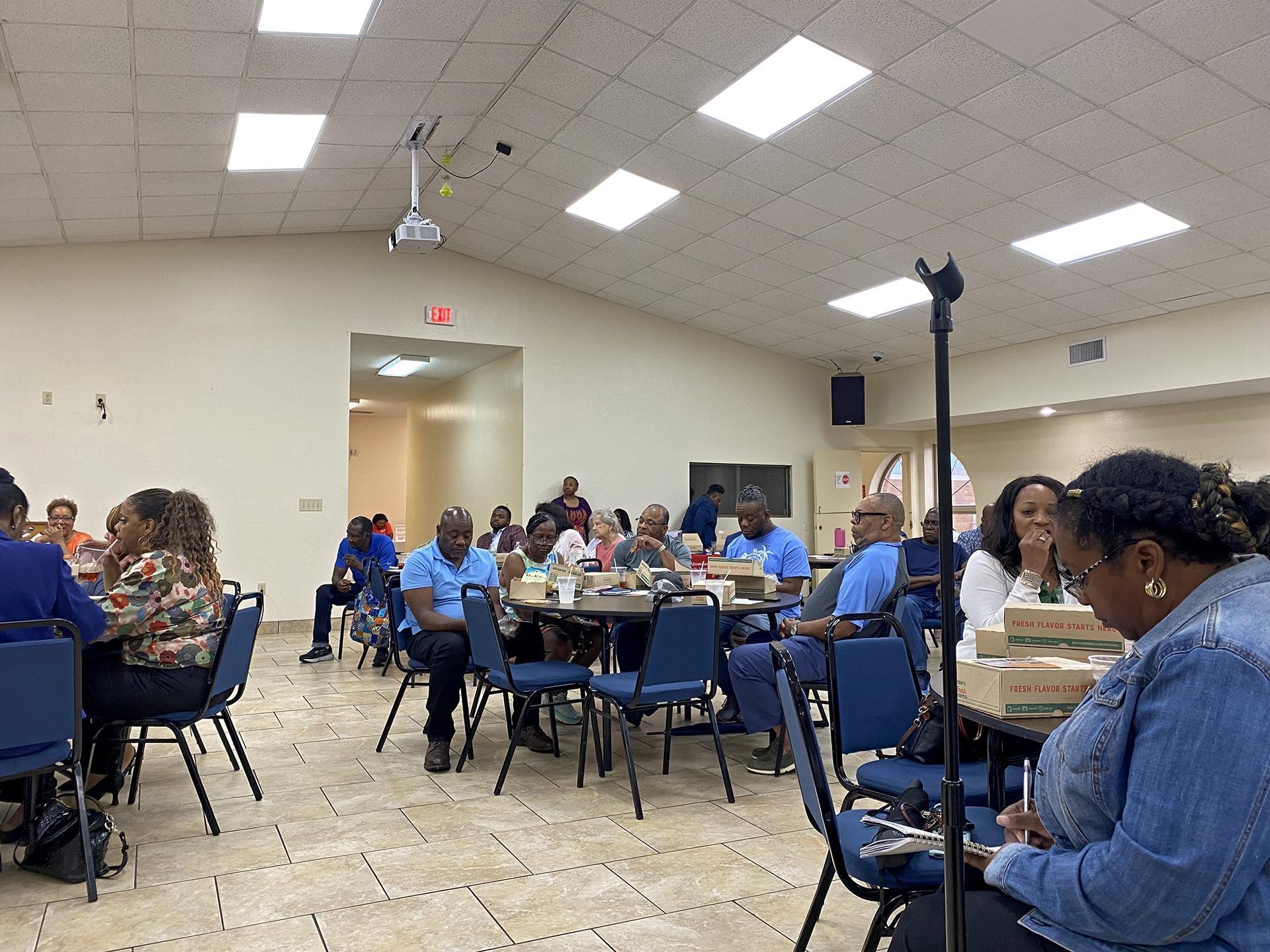
"I pray, God, that we leave here encouraged and that we leave here in solidarity with one another, to move forward into action as we represent the state of Mississippi, not just for us today, but God for those coming tomorrow," DeLoach said.
The crowd responds with an "Amen," then turns to the matter at hand: voting in the South.
They're assembled for the People's Hearing, an effort by the Mississippi Voting Rights Act Rapid Response Coalition, a group of around 40 local and statewide organizations united in their work around voter advocacy and education, to allow Mississippians the opportunity to offer testimony on their experiences voting.
After a voting rights rally this past May in Jackson, Mississippi, in response to the U.S. Supreme Court’s decision in Louisiana v. Callais — which says states cannot draw congressional district lines based on race, undoing the landmark 2023 Allen v. Milligan decision which redistricted Alabama — organizers decided to create the People's Hearing community meeting series to travel across the state to hear from residents from all walks of life.
One Voice, a Jackson-based nonprofit, was among the organizations represented at the People's Hearing in Southaven. Executive director Nsombi Lambright-Haynes said that in seeing the sheer number of people at the Jackson rally, she realized hearings were needed in all parts of the state. Southaven was the second stop on their tour. Clarksdale, Mississippi, has also hosted a People’s Hearing, and there are plans for another in Meridian, Mississippi, later this week.
"These hearings really came from communities saying, 'Hey, we've been in Jackson. Now we need you to come to other parts of the state so that we can tell you what's going on in our neighborhoods,'" Lambright-Haynes said.
She's heard from dozens of residents concerned about public education, quality healthcare and infrastructure — many of them worried about the future of their communities.
"They are concerned that they may not be able to elect the representative of their choice as a result of this decision," she said.
Residents from Southaven and neighboring cities Olive Branch and Horn Lake offered testimonies on their experiences voting. One spoke about being stereotyped as a Republican because she is a white voter. Another voiced frustration with DeSoto County, where Southaven is located, having one of the fastest-growing Black populations without many, if any, Black elected officials.
New Albany resident Chris Sanders said it's embarrassing that the Callais decision is spurring Mississippi's legislature into redistricting.
"It seems like it's just turning back the hands of time when there needs to be progress," Sanders said.
Sanders said he's seen how disillusioned people have become with the voting process.
"(There are) not too many people voting and not believing in voting because they say that 'Well, what's the reason to vote? Why should we vote? They're not going to do anything. They're not going to represent us,'" he said.
Sanders points to the Voting Rights Act of 1965, saying life for many Black Mississippians improved, from job access to better educational standards. He hopes that by using his voice at the People's Hearing, he'll encourage younger voters to take action.
"You have that opportunity. You have that right to vote. Voting gives you power, and voting can also make a difference," he said.
DeSoto County has been the setting for two lawsuits in recent years. Harris v. DeSoto County argued that 2022 redistricting diluted Black voting power. Foster v. Mississippi, filed earlier this month, argues that by creating a Majority-Minority subdistrict for chancery and circuit courts, the Mississippi Legislature violated the Voting Rights Act.
Amir Badat, a voting rights attorney with Fair Fight Action, said that Mississippians are living through a moment of uncertainty as Section 2 of the Voting Rights Act of 1965 is being weakened.
"Now the question before us is how do we rebuild our democracy after the Supreme Court has cut its legs out from under it," Badat said.
Badat said the People's Hearing series echoes convenings post-Civil War, when Black Mississippians gathered and kept a record of community voices, presenting them to Congress and eventually influencing the 13th, 14th and 15th amendments.
The People's Hearings are a chance to create a record that can be presented to the Mississippi Legislature once lawmakers call a special session for redistricting. Mississippi Gov. Tate Reeves scheduled a special session for redistricting earlier this summer, but soon after cancelled it.
"That's what these community hearings are about — to hear from actual people who are living in community and working and voting, or not voting, about what the issues they face are and what the solutions they want to see their leaders pass are," Badat said.
Maya Miller is a Report for America corps member covering democracy and government for the Gulf States Newsroom. This story was produced by the Gulf States Newsroom, a collaboration between Mississippi Public Broadcasting, WBHM in Alabama, WWNO and WRKF in Louisiana and NPR.