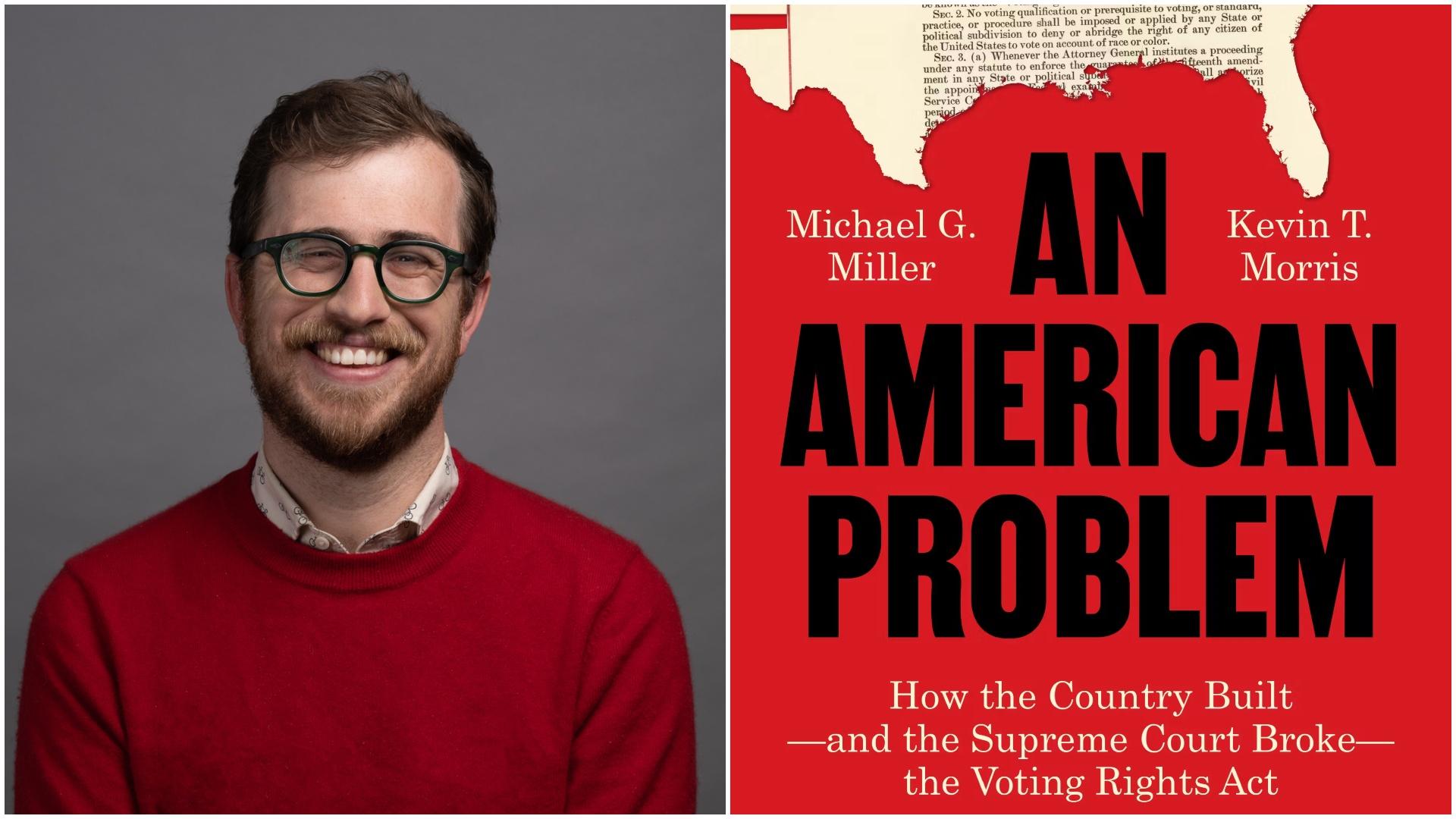
MAYA MILLER, BYLINE:
So, talk to me about your book. What sparked your interest to dive deeper into the history of the Voting Rights Act?
KEVIN T. MORRIS: I work for a group called the Brennan Center. We're housed at the law school at NYU, but we're kind of a fun mix of lots of different people doing lots of different things. So I'm a political scientist studying voting rights, but I work with a whole bunch of lawyers who litigate cases under the Voting Rights Act, and I work with policy advocates who are trying to restore the Voting Rights Act. My piece of this larger fight, so to speak, is bringing the kind of empirical and academic rigor to understanding what's been happening to voting rights in the United States.
So part of this kind of grew out of research that we were doing, my co-author Mike and I, about the effects of Shelby County, but then also we wanted to go and really tell the story of where did the Voting Rights Act come from, and how was it a real response to the conditions in the country in the 1960s and earlier.
The Voting Rights Act didn't come out of nowhere, right? It came out of a specific set of historical circumstances, and those look a whole heck of a lot like the country does today, with some real serious kind of what we would call democratic backsliding, but real threats to multiracial democracy. So when we set out to write this book, we wanted to tell both sides of that story. Where did the Voting Rights Act come from, and what have we lost since the [Chief Justice John] Roberts [U.S. Supreme] Court has really started attacking it and really dismantling it over the last 10 to 15 years?
MILLER: Let's talk a little bit about Shelby County v. Holder. It struck down the Act’s preclearance formula, which completely changed federal protections. Could you talk a little about that?
MORRIS: One of the really big pillars of the Voting Rights Act of 1965 was Section 5, or what was usually called the preclearance regime. What was the preclearance regime? Well, it required parts of the country with a history of race discrimination in voting — and I should say, an especially egregious history of race discrimination in voting because, as we know, race discrimination is not only in the South or only in one part of the country — but it required parts of the country with an especially bad history of race relations in voting to get permission from the federal government before they could make any changes to their election practices.
Usually in the United States, we see local governments that can make changes. They can make policy changes, or states can pass laws, and they're assumed to be legal until someone challenges them in court. Preclearance kind of flipped that script a little bit, and it required these parts of the country with these especially bad histories of discrimination to get permission before they could change them.
Now, there was what we call the coverage formula as part of the law that laid out exactly what parts of the country had to get permission from the federal government before they could make those changes.
In 2013, the Supreme Court struck down that formula that was used to determine what parts of the country had to get permission before they could change their policies in Shelby County. So in Shelby County, the Roberts Court doesn't strike down the idea of preclearance itself but instead, that formula that's used to figure out what parts of the country had to go through that kind of a special, especially rigorous process to prove that they weren't gonna discriminate against voters of color. They kind of pulled out one little piece of the Voting Rights Act, and they said, "All we're doing is striking down the coverage formula. Congress can pass a new coverage formula."
But of course, Congress has been incapable of doing so for the last 13 years, which means that no parts of the country are required to get that permission before they can make changes to their election practices anymore.
MILLER: “An American Problem” opens with an introduction that includes a quote from Martin Luther King, Jr. It says, "Give us the ballot, and we will no longer have to worry the federal government about our basic rights."
And I think that's interesting because we're seeing, at least in our region, residents have long taken a stance that says, "Hey, we need water. Hey, we need hospitals, we need better public schools." And in some ways, some might say we're still in 1957 advocating for basic rights and worrying the government all the while.MORRIS: I think that's exactly right, and it's why it is dangerous to see the United States, and especially the Supreme Court, walking backwards on voting rights right now.
We know that the Voting Rights Act was tremendously successful. We saw not only huge numbers of Black Southerners registering and voting for the first time, but we saw an enormous increase in the number of Black elected officials. We can think about all the way up to Barack Obama in 2008, but also down to the local level. Thousands of Black individuals were elected to school boards and city councils, and we know that this had a big impact on economic opportunities for Black Americans.
We know that opening up electoral democracy to Black Americans was very good for those communities. But as you just hinted at, to use Dr. King's language, we have not reached the promised land, and despite the fact that a Black man was elected in 2008, we never reached the promised land. We were making good progress. We've made a tremendous amount of progress since the 1950s, but of course, Black Americans still suffer from all sorts of systemic racism in the United States.
So to see the tools being dismantled before we've ever really gotten to a place of equality, before we've ever really gotten to a place where our electoral institutions and our politicians can take care of the communities that they're supposed to be representing, is a tragedy, frankly. It's deeply saddening and deeply angering too, I should add.
MILLER: Another interesting point from the book — you begin with a narrative about Benjamin Brim and the violence he faced from the Klan, and you also tie in a narrative about John Lewis and the violence he faced in Selma.
You talk a lot about the people who have put their lives in danger fighting for the right to vote. Could you talk a little bit about how that narrative of people who have laid their lives on the line — I think your dedication even says something like "The thousands of untold people who lost their lives for the right to vote" — so the importance of making sure those stories are told when we talk about voting.
MORRIS:You know, it's something that I've been thinking about a lot this fall. I go to a Presbyterian church, and we've been reading the story of Exodus, and [I've] been thinking a lot about life on the road and what does it mean when we might not see the promised land, when we might not get to the place that we're all working for. I learned the story of a man named Maceo Snipes while I was researching this book. His story really stuck with me, so if you don't mind, I would love to share it.
Maceo was a Black man from Georgia, and he served in World War II in the Pacific Theater, and he spent the Second World War overseas fighting fascism. He comes home to Georgia, and he says, "I was just fighting for freedom, for equality overseas, and I come home to Jim Crow Georgia, and I'm not allowed to vote."
He actually cast a ballot in the 1940s for the governor's election in Georgia. He's the only Black man in his county who cast a ballot that year, and the next day, the Klan shows up to his grandfather's home where he's living, and they murder him for doing it. They take his life for standing up for what he believed in, and to this day, we don't know where Maceo Snipes' body is buried.
His murder prompts a young 17-year-old at Morehouse College to write his very first letter to the editor, and the 17-year-old says, "We're gonna stand up. We demand civil rights for Black Americans. We demand voting rights for Black Americans." That 17-year-old was Martin Luther King Jr., who, of course, then, as we all know, goes on to become one of the great leaders for the Black freedom movement.
So why is Maceo's story on my heart these days? He had no idea that by standing up for what he believed in, he was gonna be part of this big freedom movement, and yet he was.
So these men and women fought, and some of them died. Some of them paid the ultimate sacrifice. They watered the ground for what came after them. I'm not saying, hopefully, that any of us are going to have to give our lives for the right to vote right now, and I want to be especially conscious of the fact that I am a white man talking about this, so the risks are different for me. But I think that we're all called to fight for political equality, to fight for justice.
We don't know how the actions we take today are going to inspire that next generation. When I think about, "How do I keep hope? How do I carry these stories with me?" I like to think back to some of these individuals and think about how they didn't necessarily know how their actions were going to echo through history, but they did, and they continue to.
MILLER: What do you think is the biggest threat to voting rights in this moment that we're living in, especially with the recent Louisiana v. Callais ruling and even further back, Shelby County v. Holder? What do you think is the biggest threat?
MORRIS: I hate to be pessimistic, but so many of the threats have come to pass at this point. Many of the dangerous things are not threatening so much anymore as they are kind of the real law of the land at this point.
Threats looking forward… the congressional elections that are gonna happen next month. We already know right off the bat, Alabama, Louisiana and Tennessee have all gotten rid of Black majority congressional districts.
Right off the top, we know that Black turnout may very well be very high. That would be great. There's a lot of anger. There's a lot of enthusiasm in the Black community, but because of how these maps have been redrawn, it's going to be basically impossible to get those seats back and get candidates elected that are the candidates of choice of those Black communities. We're at a moment right now where the effects of these laws are already being felt, and they're already dismantling congressional representation for Black Americans.
In the book, Mike and I spend a lot of time talking about what's happening at the local level, too, because we think all the time about congressional elections, and those are obviously super-duper important, tremendously important, but so too are school board elections and city councils and utility districts.
This is actually where we see so many of the effects of Shelby County, and we know Brnovich and Callais as well are gonna show up at that local level because Section 2 and Section 5 were always the most effective at blocking discriminatory policies at the local level, always used for county councils and those sorts of things. As we think about what's going to happen in the coming years, we absolutely need to be focused on Congress and fighting back and making sure that Black Americans continue to have the opportunity to elect candidates of choice to Congress, but we're also going to need to pay a tremendous amount of attention to what's happening at the local level.
MILLER: So tell me, now that your book is out, what's next?
MORRIS: For me, I am really excited. I'll be coming down to the South to share the story of this book in a number of places. I'll be in Atlanta, in Birmingham, in Montgomery, in Jackson. I'm really looking forward to getting down to the South and spending time again with the folks who are the most impacted by these decisions.
When I think forward over the next few years, we kind of end the book with a call for federal action. These states, especially states with these really nasty histories of racial discrimination, are not going to police themselves. Congress knew that in the 1860s when they passed the 15th Amendment and when it was ratified in 1870. Congress knew that in the 1960s when they passed the Voting Rights Act.
My attention now is really focused on how do we push Congress to take advantage of its powers under the 15th Amendment to really make good on the founding ideals of this country. We want to use this book as a cudgel to hit people in Congress over the head and say, "You've got to enforce the 15th Amendment. You've got to take steps to make sure that voters of all races and ethnicities have the opportunity to participate in our democracy."
Maya Miller is a Report for America corps member covering democracy and government for the Gulf States Newsroom. This story was produced by the Gulf States Newsroom, a collaboration between Mississippi Public Broadcasting, WBHM in Alabama, WWNO and WRKF in Louisiana and NPR.