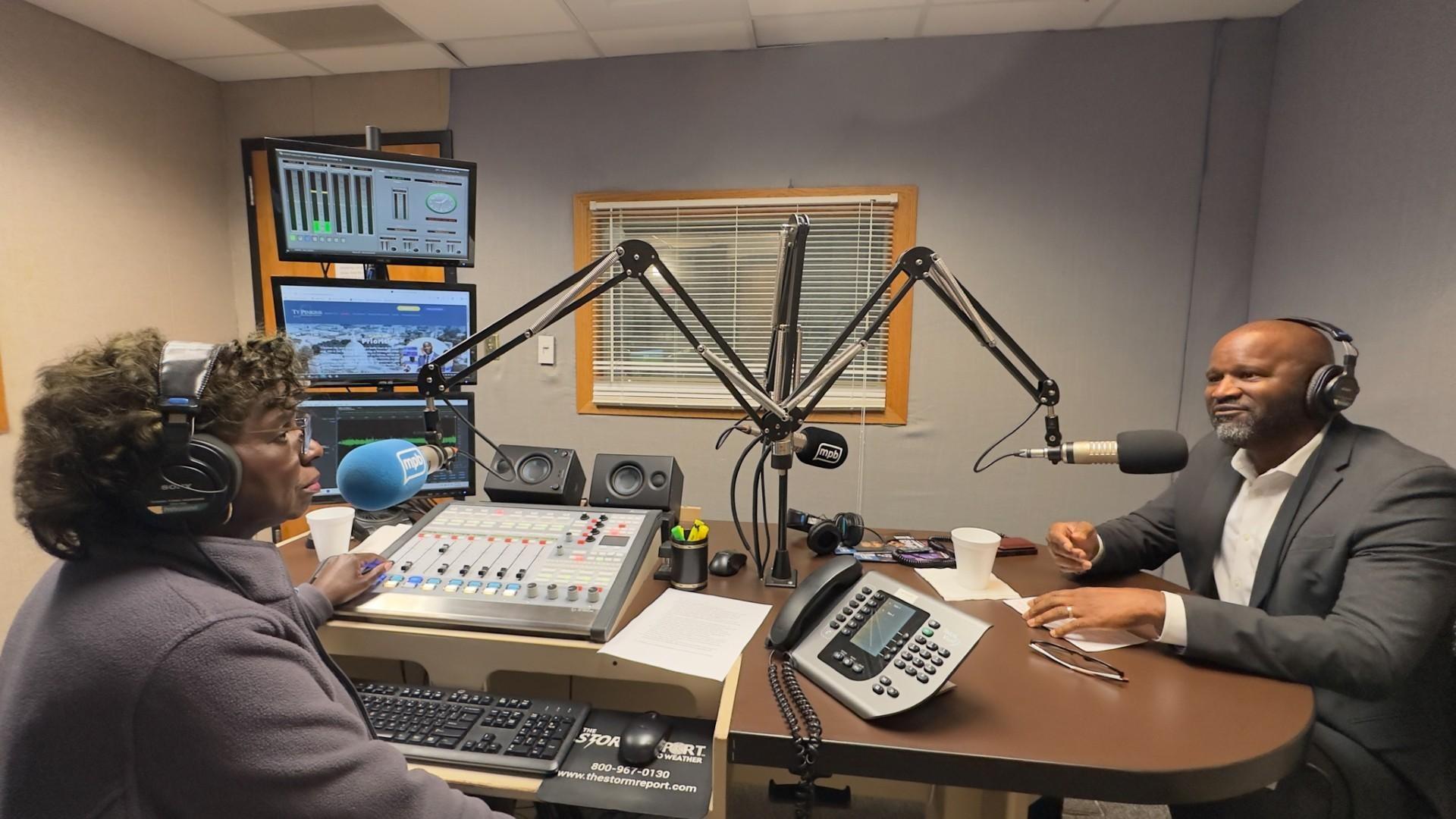
Frazier: Joining me today is Ty Pinkins, a Mississippi native who is running for the U.S. Senate. Thank you so much for coming in.
Pinkins: Thank you for having me. Happy to be here.
Frazier: We are just days away from the election, November 3rd.
Pinkins: Around the corner
Frazier: Why are you running for this office?
Pinkins: Well, I care about our country, I care about our state, and I care about making sure that everybody has access to an option on the ballot. I am from the Delta, born and raised, first person in my family to graduate high school. My mother dropped out at 15 to give birth to me. My stepfather, who met my mother, had already dropped out in the sixth grade, never learned how to read. And some kind of way, they figured out how to get me out of high school, and I did.
I graduated and joined the military, served 21 years, three combat tours, over 36 months at war. Then after retiring from the military, I went to Georgetown University Law Center and earned two law degrees. For the past six years, I have been practicing law for free in some of Mississippi's most underserved communities. Some of the experiences that I had while helping low-income community members navigate the justice system is what kind of provoked me to run for office, particularly this seat for the United States Senate.
Frazier: What makes you qualified to run for the office?
Pinkins: Well, I meet all the technical qualifications in accordance with the Constitution like…
Frazier: What technical qualifications?
Pinkins: The age requirements, being a United States citizen, living in the State of Mississippi, those particular requirements. But beyond that, wanting to make sure that people have a different option on the ballot this year as opposed to the same two options that they typically have.
Frazier: You're running as an Independent. You are a former Democrat. Why compete in this way?
Pinkins: Well, I don't think that we belong to either political party. I don't. I don't think the Democratic party owns voters. The Republican party doesn't own voters. Voters deserve an option, whether that be a Democrat, Republican, or an Independent. And my independent candidacy is giving people an option who are tired of voting for the same two options every single election cycle.
What I tell people is I served this country for 21 years, fighting for people's right to vote in combat. And what runs parallel to that is also people's rights to challenge their government or question their government if they're not satisfied with who's in office and who's running for office. But what runs in parallel to this is also my choice to run for office if I want to, to use the same right that I fought to protect and defend for other people. So, when people push back and say, well, why are you running? I'm an American citizen just like everybody else.
Frazier: Is that the response that you're getting from voters?
Pinkins: Well, some voters ask that question, and I think it's a valid question. I do. And I think that's part of the package when you get ready to run for office, you have to be ready for and accepting of people who agree with you and people who don't agree with you. I think that's the most beautiful part of our democracy. There are people who say that they support me, there are people that ask me questions about my candidacy, and I'm open to all of those questions.
Frazier: The biggest issues this campaign season have been high gas prices, increased grocery costs, increased cost of health care, rural hospitals closing. What's your plan or message to folks who are struggling in this state?
Pinkins: I think you're talking about the affordability crisis, and it touches on so many things, and you just mentioned several of them, health care, housing, our kids' education. And what I tell people is those things are very, very important. We can want health care, housing, we can want quality affordable health care and education until we're blue in the face. But we also have to acknowledge the cost of health care didn't just rise this year.
The cost of housing didn't just go up this month. The cost our children’s education, it didn't just increase this semester. These things have been going up, up, and up for decades. The only thing that's remained constant is the same two political parties have taken turns being in office while the cost of living has gone up, up, and up.
Here's a data point for you. In 1973, the cost of healthcare the United States spent $400 per person per year on healthcare in 1973. Today it's $15,000 per person. In 1973, a newly built home cost $35,000. Today it is $400,000 on average across this country. And the last one, in 1973, we could pay $500 per year to send our children to a public four-year university. Now it costs $12,000 a year. And the problem is, we have the same two political parties that have had opportunity after opportunity to fix these issues, and all that they do is argue and fight with each other. Until we send independence to Washington, D.C., to hold them accountable and to force them to work on these issues and negotiate, we're gonna keep facing the same issues.
Frazier: Well, the race between Scott Colom and Cindy Hyde Smith is very competitive.
Pinkins: It is.
Frazier: And it looks like one of them is going to win. So where do you fall in this? Because you say people want independence. But historically, independents don't win races. They bring up issues. They can be a spoiler. But they usually don't win. Are you trying to be a spoiler?
Pinkins: I think that’s an excellent question. That’s an absolutely excellent question and you're talking about the split the vote argument. And it comes up on the campaign trail often as well. People say the Independent can't win. I say, well, based on history, a Democrat can't in Mississippi statewide. Since 1982, there have been 15 United States Senate races in the State of Mississippi. Fifteen. The Democrat running against the Republican has lost all 15. Straight. In a row.
There have been six gubernatorial elections since the year 2000. That was 26 years ago. The person running as a Democrat has lost all six. Six plus 15, that's 21 straight races. To really get to the foundation of the issue, in 2023, we had a white man named Brandon Presley that ran against one of the most unpopular governors in the country, in the State of Mississippi, with one of the most popular names in Mississippi and lost.
In 2018, we saw the same issue that's happening in this election. Today, we have three people in the race. We have a Democrat, a Republican, and an Independent, Cindy Hyde-Smith, Scott Colom, and Ty Pinkins. Three people. And the argument is that the Republican and the Democrat are tied. They're so close. Democrats are saying “this is our opportunity. We got it.” In 2018, the same scenario existed. Mike Espy, Cindy Hyde-Smith, and the third candidate.
Frazier: So, are you saying they should give up hope or throw in the towel?
Pinkins: No, No. I'm not saying they should give up hope. You mentioned history a few minutes ago, where you said that an Independent can't win based on history. I'm providing evidence that a Democrat has not won based on history.
Frazier: How does that help your cause?
Pinkins: People need to have a third option. I think people are frustrated with that, and that's what I'm hearing on the campaign trail. People are frustrated with being forced to vote for the same two options every election cycle here in Mississippi. And my argument is this, especially with black voters. If we've allowed a party to convince us to push our black votes into the Democratic corner on 21 straight occasions, and we've lost 21 straight times. Does it make sense to do that on a 22nd try, when black people constitute 38% of Mississippi's population, white people make up 57% of the Mississippi population.
Most white people in this state vote Republican. Most black people vote Democrat. And we've seen over and over again in a head-to-head race between a Republican and a Democrat that those conservative Republicans, veterans, moderates, disaffected Republicans, are not going to skip over the center and come all the way to the left, just like many of these Democrats are not gonna go all the way to the right to vote for a Republican. Until we start to join our votes with those in the middle, you're gonna keep getting exactly what we've gotten. If you keep doing the same thing you've always done, you'll keep getting the same things you always got.
Frazier: A lot of prominent people are coming to the state for either Scott Colom or Cindy Hyde Smith. We've got President Trump. He's here. We've had Vice President Kamala Harris, she's been here. Pete Buttigieg, former transportation secretary, he's here, who's coming for Ty Pinkins?
Pinkins: I am not looking for anybody outside of our state to come for me. I'm talking to Mississippians, everyday voters. I think that that reveals a huge issue with candidates running for statewide office in Mississippi, particularly in this race, where we have the Democratic candidate that has to bring in former presidents, former vice presidents, United States senators from outside the state in order to convince people in Mississippi what to do with their vote.
I think that's probably one of the most disrespectful things you can do, is come to Mississippi and tell people you know more about their lives and how they should cast their votes than they do.
One of other problems that I have is the underlying issue with all of these people coming to Mississippi is an organization called AIPAC, A-I-P-A-C, the pro-Israel organization. Cindy Hyde-Smith has accepted nearly $500,000 from AIPAC, a half a million dollars. She's bought. It's gone. But the Democrats' hands are not clean in this thing either. Every single United States senator that's come to Mississippi to campaign on behalf of the Democrats, Scott Colom, has accepted money from AIIPAC. Chuck Schumer, who initially recruited him, $1.5 million from AIIPAC. Let me finish.
Frazier: How much do you have in your budget?
Pinkins: Let me finish that statement, let me finish that statement and then I'll answer that question. Chuck Schumer, $1.5 million from AIPAC. Cory Booker, $1 million from AIPAC. Raphael Warnock, $500,000 from AIPAC.
Frazier: We're talking about Mississippi people. Let's keep this Mississippi.
Pinkins: We are. We are, but this goes to your question.
Frazier: Okay, so how much do you have in your budget?
Pinkins: This goes to your question.
Frazier: Please, how much do you have in your budget?
Pinkins: This is the decision that I made when we first started this campaign because I think money is the biggest problem in our politics. The biggest problem.
Frazier: And the issues you raise are not that they're not valid, but we're talking about running for Mississippi Senate. I'd like to focus on that and not get into national people outside Mississippi.
Pinkins: But you, you brought that up.
Frazier: I said they came to Mississippi. I did. I said they came to Mississippi and I asked you who came for you and you said no one has come for you.
Pinkins: I said that I don't need people outside of Mississippi to come for me. I'm talking to everyday Mississippians.
Frazier: Right, so let's focus on Mississippi, okay? In terms of talking about issues, I mentioned high gas prices, health care, groceries. What are you going to do about those issues? Where do you stand on those?
Pinkins: First, I'm going to answer your first question. You asked me how much money I have. I made a deliberate, conscious decision when this election first started. I said that I'm not taking money for millionaires, billionaires, corporate PACs, nor lobbyists, because I think that's the problem in our politics today.
Both my Democratic opponent and Republican opponent have taken exactly that money. I also promised Mississippians that I would not buy sale or trade stock. I literally don't own any stock. And I told Mississippians that at the beginning of this campaign, both my Democratic opponent and my Republican opponent, both of them, neither of them can say any of that.
So, when you ask how much money is in your campaign account, money is the issue. And voters need a clean candidate that's not tied to the millionaires, the billionaires, the corporate PACs, nor the stock market. Voters need a clean candidate that is not tied to either political party, the Republican Party, nor the Democratic Party. That is what I'm offering voters this year.
Frazier: And how much have you raised?
Pinkins: I have raised over, what is it, about $105,000 thus far, $106,000, not a dime from a corporate PAC. Neither of my opponents can say that. If you go to FEC, you're a journalist, if you go to the FEC website today and type in my opponent's name, it will show you that Cindy Hyde-Smith has over 100 pages of corporate PAC money. Scott Colom has over 40 pages of corporate PAC money. So, when people ask how much money you have, I think we need to look at the underlying question, what is that money doing to our politics? And we see that today. It's drowning out every day Mississippians' voices.
Frazier: Have you been able to have enough money to buy ads and do signage and that kind of thing?
Pinkins: I’ve had enough money to drive around this state twice. I've been to all 82 counties twice, and I've had enough money to talk to Mississippians and let them know what I stand for, the issue that I'm fighting for, and that I am fighting for them. And I think we get wrapped up so much in, have you raised enough money in order to craft a campaign commercial that really doesn't let Mississippians know who you are,
Frazier: To craft a fancy campaign commercial?
Pinkins: To basically mislead people, when on ten different occasions this year, ten different occasions, the Democrat, the Republican, and the Independent have been invited to participate in joint debates, joint town halls, joint forums. The Democrat in this race, Scott Colom, and Cindy Hyde-Smith, the Republican, have refused to participate in any debates. So, when people ask those questions—
Frazier: Well, wait a minute. I have seen press releases where Scott Colom has invited Cindy Hyde-Smith to debate. So, I would question that. But moving on.
Pinkins: But I would question also this right here. Millsaps College right here in Jackson, Mississippi, Scott Coloms' alma mater invited Scott Colom to participate in a debate that was supposed to take place in September of this year. He was invited in May, in May. They invited all three of us at the same time.
Scott Colom turned down that debate opportunity in addition to the University of Southern Mississippi debate opportunity in which Cindy Hyde-Smith is an alma mater of. She turned that down. That's just two of eight debate, 10 debates for nonpartisan organizations where the Democrat and the Republican would not participate. And at the same time that, Scott Colon made that commercial saying that challenging Cindy Hyde-Smith to a debate, he was literally turning down debates from these institutions.
Frazier: That may have been, and I'm not on his campaign, but that may have been because Cindy Hyde-Smith did not agree to the debate. So, what was the point in having the debate? I'm just saying this. He might have thought of you as a long shot.
Pinkins: No, the point in having a debate is not whether your opponent participates in it or not. The point in the debate is giving voters and Mississippians an opportunity to examine your issues, examine how you answer questions under pressure. So, it shouldn't be predicated on whether or not your opponent participated or not, and to your second point, he may have assumed that the Independent was not strong enough.
I think this year, you have two successful black lawyers running for United States Senate. And in our community, the black community, we say we want to get young people involved, we want to raise turnout. I think it's a tragedy, a tragedy that the black community did not get an opportunity to see these two successful black lawyers stand in their communities and argue their issues.
Whether you believe that the independent wasn't viable or not, the issue is, we have a candidate that would not stand in front of the black community and give them that opportunity because it doesn't come that often.
Frazier: What's your closing message in the final days?
Pinkins: My closing message in the final days to Mississippi is this:
We have a unique opportunity with regard to my independent candidacy here in Mississippi. Right now, there are six veterans running for U.S. Senate across this country as independents. Montana, South Dakota, Idaho, Nebraska, Colorado, and Mississippi. Six rural states. We're all veterans. We're running for United States Senate as an Independent. We're working together.
Today, the Senate has split 53 Republicans, 47 Democrats. Our goal is to prevent either party from having a majority in the United States Senate. If we do that, if only a few of us win, those three independents are going to be some of the most powerful people in Washington, D.C., which means committee assignments, farm bills, medical bills. Any legislation has to go through those independents in the middle.
People always say Mississippi is last in everything good and first in everything bad. Now we have an opportunity to have one of the independents in Washington D.C. that control legislation. This is our chance. So that's one of my messages to Mississippians. I hope that Mississippians will go to my website, www.typinkins.com and don’t donate to me. I don't want your money. I don't need your money. What I want you to do is learn about who I am, learn the issues that I'm fighting for, and make an informed decision.
Frazier: Alright. Thank you so much Ty Pinkins, an Independent Mississippi native running for U.S. Senate. We appreciate your time in speaking with us.
Pinkins: I appreciate you having me. Thank You.